

Last November, the second Rath exhibition took place at Galerie Studio Lissabon in The Hague. Rath, short for Rock ‘n’ Roll Art Collective The Hague, brought together artists from The Hague who portrayed the rock ‘n’ roll scene from The Hague’s pop capital in striking visual works.
The death of one of the core members, Marcello, of the artist couple Marcello & Els, was a great loss, but it didn’t stop the core group, consisting of Clé Moormann, Patricia Steur, Arjan van Gent, Victor Hoefnagels, and Els van den Dop, from continuing with their plans unveiled in 2024 to visually put rock ‘n’ roll from The Hague on the map. This time with Hans van Rhee, Evert de Vreugd, Maarten Verpoort, Philine van den Hul, and Rob Bolland as ‘Friends’.
Portraits of Musicians
A week after the exhibition, I spoke with two members of the collective, Victor Hoefnagels and Els van den Dop, at Galerie Pied-à-Terre on Prins Hendrikstraat in The Hague about their artistic practice and the Rath (rathpack.nl) collective.
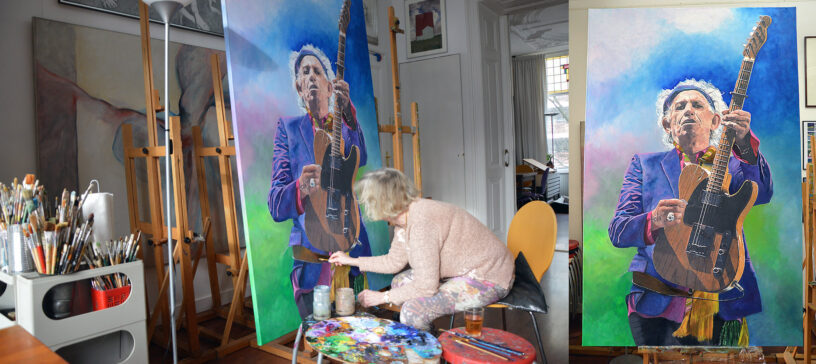
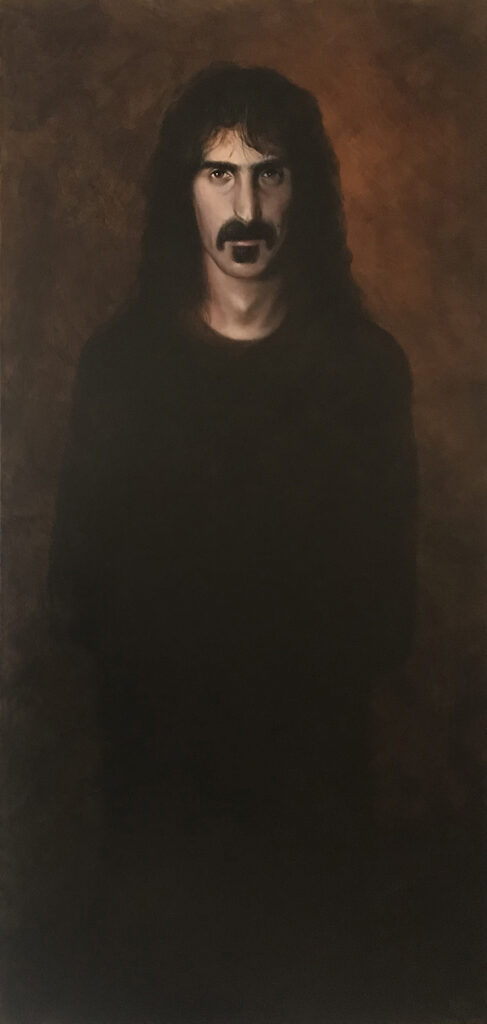
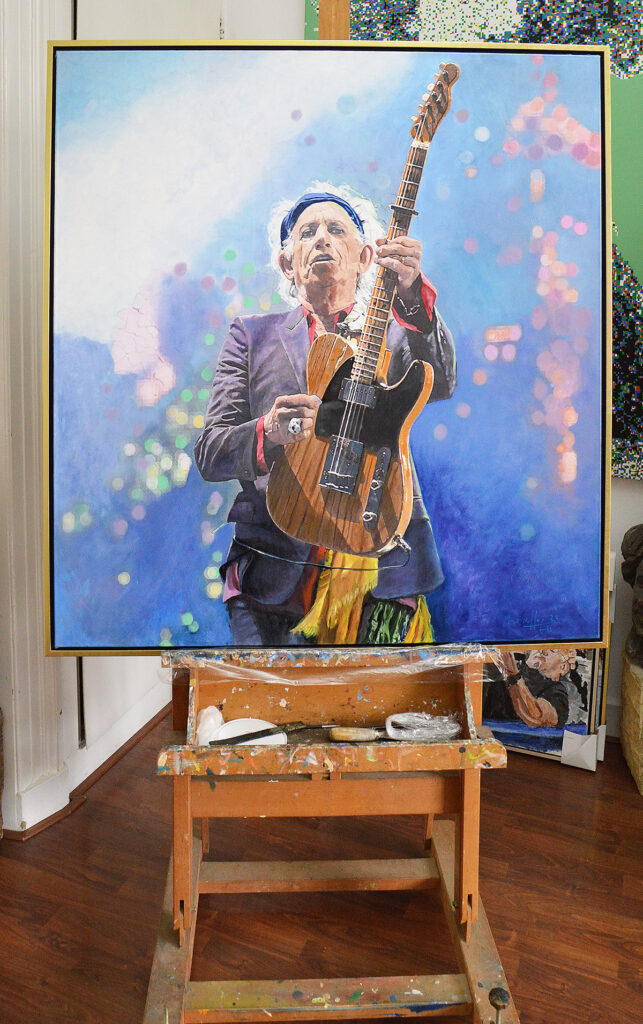
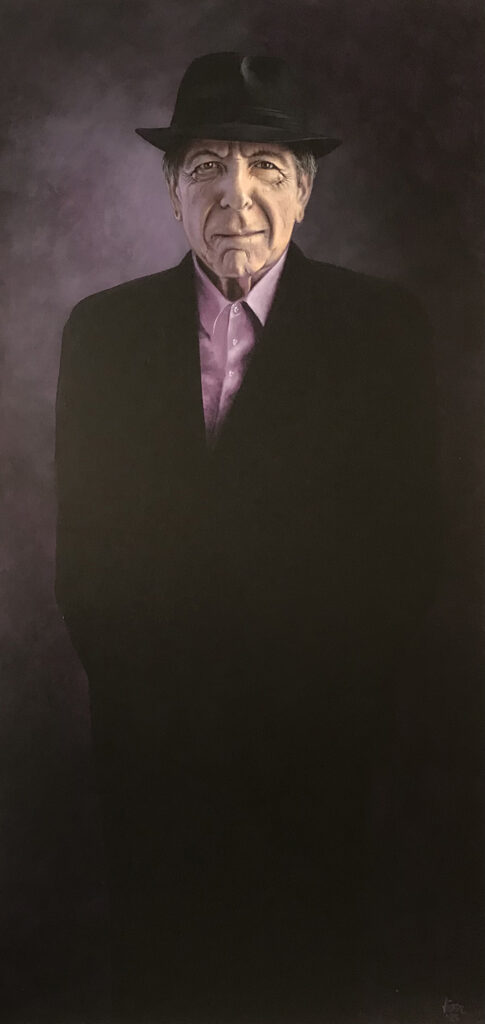
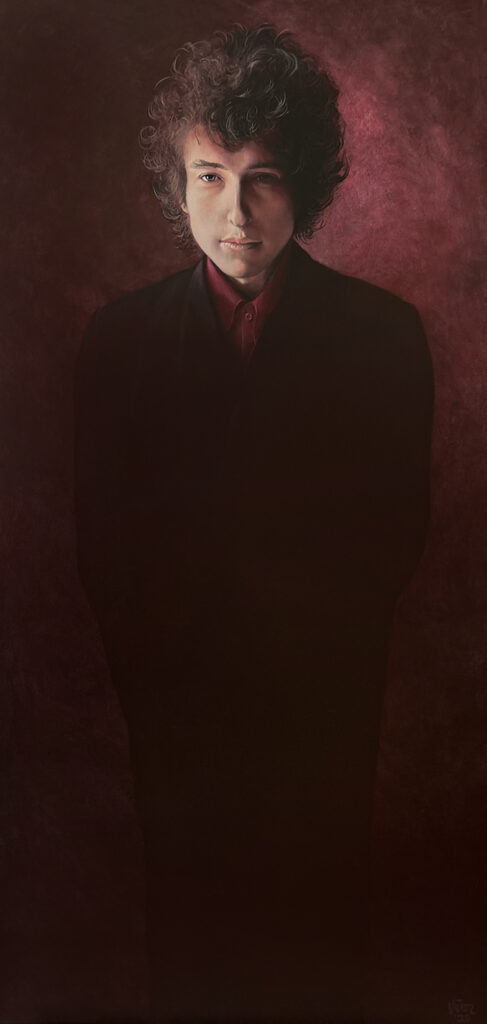
Victor showed elongated portraits of Frank Zappa, Leonard Cohen, and Bob Dylan; Els showed works of musicians in action, including Keith Richards, Jimi Hendrix, David Bowie, and David Grohl.
Victor: “The idea for Rath came from Clé Moormann, a student of mine. He only painted musicians. He had the idea to organize an exhibition with a few other artists from The Hague with a rock ‘n’ roll theme. Before we knew it, he had a group together. The first exhibition was in 2024 at Galerie Studio Lissabon. It was a huge success. Els: “The name came from Marcello: ‘We’re calling our group RATH,’ he said, Rock ‘n’ Roll Art Collective The Hague.”
Rock ‘n’ Roll in Art
“At the Royal Academy of Art, where I studied from 1970 to 1975, everyone around me was interested in rock & roll,” says Els. “There were also musicians as students at the Academy. I was in the same class as Sacha van Geest, a flautist with Supersister.” Victor: “I was jealous of Sacha because he drove an Alpha Romeo.” Els: “Which he wrecked at Plein 1813.” Both: “But he could whistle like a pro.” Besides Sacha van Geest, the group consisted of Robert Jan Stips, Marco Vrolijk, and Ron van Eck. The group played progressive rock. Sacha van Geest had previously been part of the school band The Provocation. Victor: “I played with Sacha van Geest.” Victor sings and used to play an old Wurlitzer piano. A friend of Victor’s, Lawrence James, played with bands like Fiesta Tropical, which was part of the André van Duin Show at the time. “We gathered on Schlegelstraat in Laak. That’s where all the musicians would meet.” Victor often played with his friend Lawrence, including at the sixties revival in the Kralingse Bos in Rotterdam. Els: “My first room was on Leyweg, then I moved with the Supersister bus to Rijswijkseweg, where Ron van Eck lived. It helped that I could cook Indonesian food.”

The Creatives
Painting and various musical groups were part of the same scene in The Hague: that of the creatives. Both cite examples of this convergence, such as Herman Brood, who attended the Art Academy and played music, and examples abroad like David Bowie, John Lennon, Lou Reed, and Andy Warhol, the latter primarily as an organizer. Els: “The Rock History Tour, a bus tour of the rock ‘n’ roll hotspots in The Hague, also stems from contact with the musicians.”
Els had a child in her fourth year at the Academy. Els: “I took my child to school. Mrs. Giacometti, who taught art history, brought her dog to school, so I could take my child too, I thought. I put the child in the playpen with the painting teacher, Aart Roos. My father, Leo van Meesche, also an artist, had attended the same academy and had also been taught by Giacometti before World War II. In the 1950s and 1960s, he returned to the Academy to obtain his teaching certificates (MO A and MO B). When I entered the Academy, I didn’t actually want to paint; I wanted to sculpt. But once I was there, I was told: ‘You’re a painter.’ So I started painting.”
An attic room in the Schilderswijk neighborhood (The Painters neighborhood)
Victor attended the Royal Academy of Fine Arts from 1973 to 1978. “My parents wouldn’t let me go to the Art Academy,” says Victor. “I’m from the Schilderswijk neighborhood and had been painting in an attic room since I was 11. My parents didn’t approve of my choice of art. The motto was to learn a real trade first. Ultimately, I wanted to leave home because tensions arose. I was slightly dyslexic and couldn’t get past the junior general secondary education (MAVO) level.” His continued pursuit of art came from his grandmother. “She saw it. She gave me an oil paint set and books.” But for the Art Academy, you needed at least a senior general secondary education (HAVO). He tried anyway and was told he had to take an entrance exam, and—if that went well—then an interview with the director of the Academy, then Mr. Beljon.
“I passed that exam and after the interview with Beljon, I was immediately admitted.” However, he was told, ‘We’re going to completely unlearn your approach!’ At the Academy, he took drawing and painting classes, which also included etching and lithography. “Georg Hadeler taught lithography, and we had etching lessons from Auke de Vries.”
After graduating, Victor took a part-time job at a publishing house, Elmar Publishing, for whom he designed book covers.
A portrait of David Bowie
Els’s first work about musicians was a portrait of David Bowie. She made several paintings of him. “Performers are beautiful to look at, but difficult to capture. Bowie is an intriguing person, both an artist and a performer. I’ve also made more works about Keith Richards. He’s incredibly interesting. Because of his head and all those lines in it. He played with five strings on his guitar. I had a client from Germany interested in buying a portrait of Keith Richards. He came to see me, and the first thing he did was check the number of strings on his guitar. Yes, five!”
Nina Simone
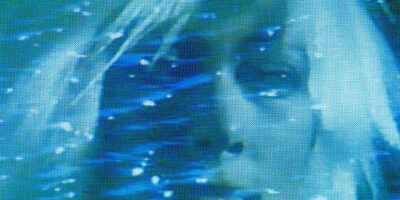
An important painting for Victor is the portrait of Nina Simone. He also used it for small pictures featuring that portrait. “It relates to her life story. It’s fascinating. That history is intertwined with the Netherlands and apartheid. She fought against apartheid. After being rejected in America, a Dutch producer managed to get her back on stage. I painted a portrait of her with an orange Co-op bag on her head, with the motto ‘Together you stand strong’. Orange is the color of freedom. A Dutch ambassadorial couple bought it. The painting hung in their residences in Jakarta and Moscow.”
How long have Els and Victor been artists?
Els: “Since I graduated from the Royal Academy. So since 1975.” Victor: “But you were already artists before then. It’s a virus you’re born with.”
Victor’s later childhood was marked by conflicts regarding his desire to become an artist. His father was a car mechanic, his mother worked in the coffee bar at De Bijenkorf. His grandmother owned Café de Hofzicht Bar at Hollands Spoor, but she never worked behind the bar herself. She made hats.
“She was the only one in the family who saw that there was something in that little boy. I got art books and an oil paint box from her, called “Painting by Numbers,” where you’d fill in the numbers on the squares of a drawing. Something completely different emerged for me. I started copying Van Gogh, then Dali, then Da Vinci. I’m left-handed by birth. That was “corrected” at school. I can write in mirror image. I became fascinated by that.”
He discovered his own style when he convinced a friend from school to take her clothes off as a model. “Only then did I start painting my own thing. That friend was the daughter of a publisher, and according to my parents, she was way above our level. I paid for my entire education with various jobs. Yet, I had a proud father. He was always there at exhibition openings.”
Themes
Victor: “My painting life is made up of themes. Each theme has its own style, method, and execution. Some themes have been and continue to be very successful. I was once told by a gallery, ‘You have to stick to your theme.’ I refused. For the recent exhibition, I made three formal portraits. Before that, a series of close-ups, portraits from very close up. But the sea and philosophical themes continue to play a role. What preoccupies me becomes my theme. A theme lasts one or two years. Music has played a major role throughout those years; musicians always returned. I did a series of models in plastic, musicians in plastic. My theme then was: ‘We have to reuse plastic, not treat it too lightly.’”
Dancers
In the beginning, Els often painted dancers. The HOT Theater, where the dancers of the Netherlands Dance Theater rehearsed, happened to be just around the corner from the Academy. For five guilders, they could attend performances. There you saw Jiri Kilian and Sabine Kupferberg. “During the intermissions, we observed. What people radiate, the language of a body. Where better to see that than in a ballet?” She also attended the Netherlands Dance Theater’s study evenings and made sketches. “I saw beautiful bodies and beautiful movements.”
What are their experiences with the art world?
Els: “It’s fun, but you have to work hard.” Victor: “In the beginning, it was really hard for me to get started. It wasn’t until I turned 50 that things really started to take off. I did a lot of odd jobs to keep my head above water.”
Both were members of Stroom. Els: “Back then, we had open registrations, where you could register as an artist for a project/artwork in a public space. Three people were selected for each project/artwork. You were paid for that.” Els created designs for the Coornherthuis on Erasmusplein, the Ockenburgh Crematorium, the gymnasium of a Montessori school, and a tree on a small square in Kraayenstein.
In addition to his art practice, Victor held various jobs. Through Ten Hagen publishing house, he received a design commission for the magazine De Architect. He also wrote articles for that magazine, including one about the one-percent tax rate.
For his final exam at the Academy, he presented the “Wilhelmina Project.” A route with posts that began at the Knight’s Hall (Ridderzaal) and ended at Charlotte van Pallandt’s statue of Wilhelmina at Noordeinde Palace, with the motto “God is the universe, Wilhelmina rules on behalf of God.” And to represent that universe, a route with posts. He received an eight. However, the project was never realized. There was, however, a model measuring two and a half by two and a half meters, which he left behind in the Academy Building. “Every now and then I dream that I’m walking in the basement of the Royal Academy of Art and Art and find the model there. How your past continues to haunt you.”
Finally,
They both find the act of creating more important than owning the painting. Once it’s finished, it can go. Els: “I’m glad there are people who want it. Many people come to me for portraits of their children. I want to know a little bit more about the background of those children.”
See also the video:
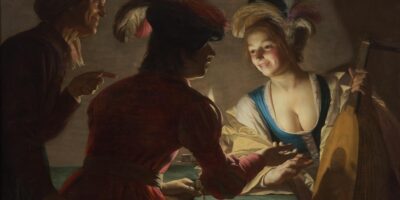
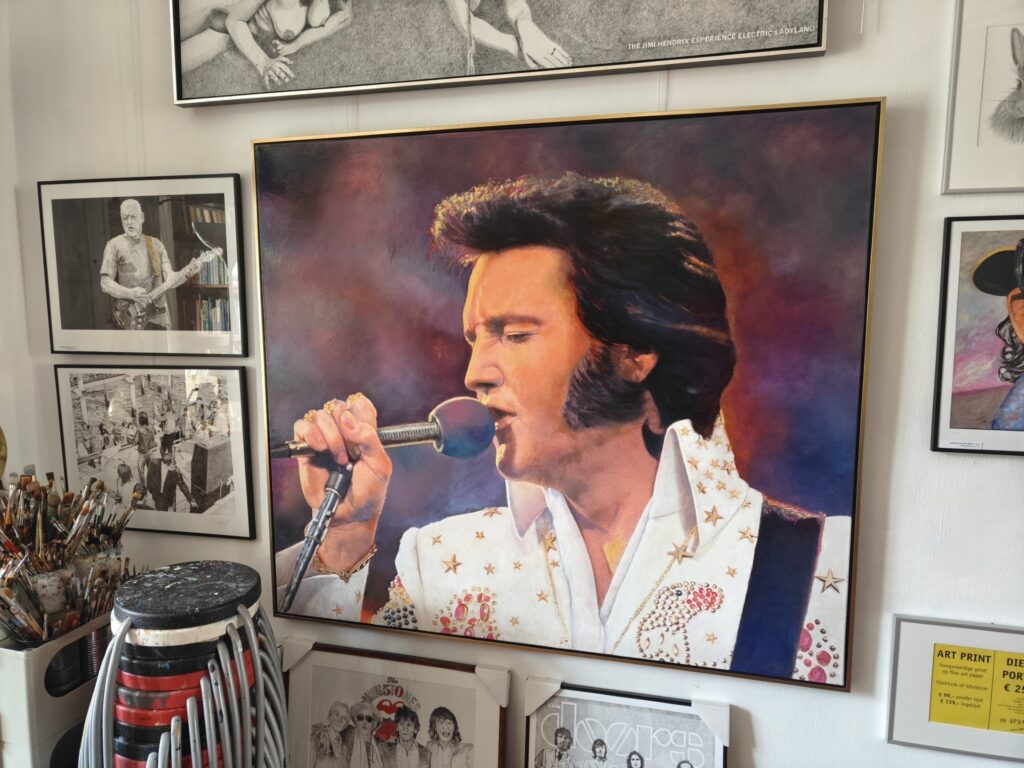
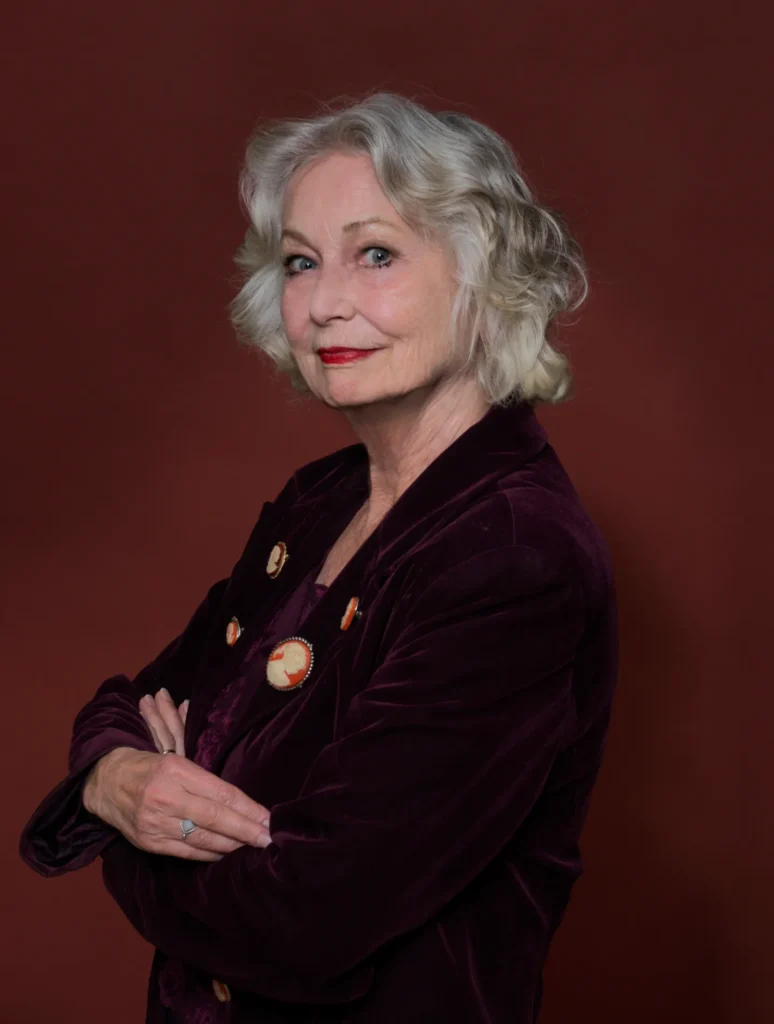
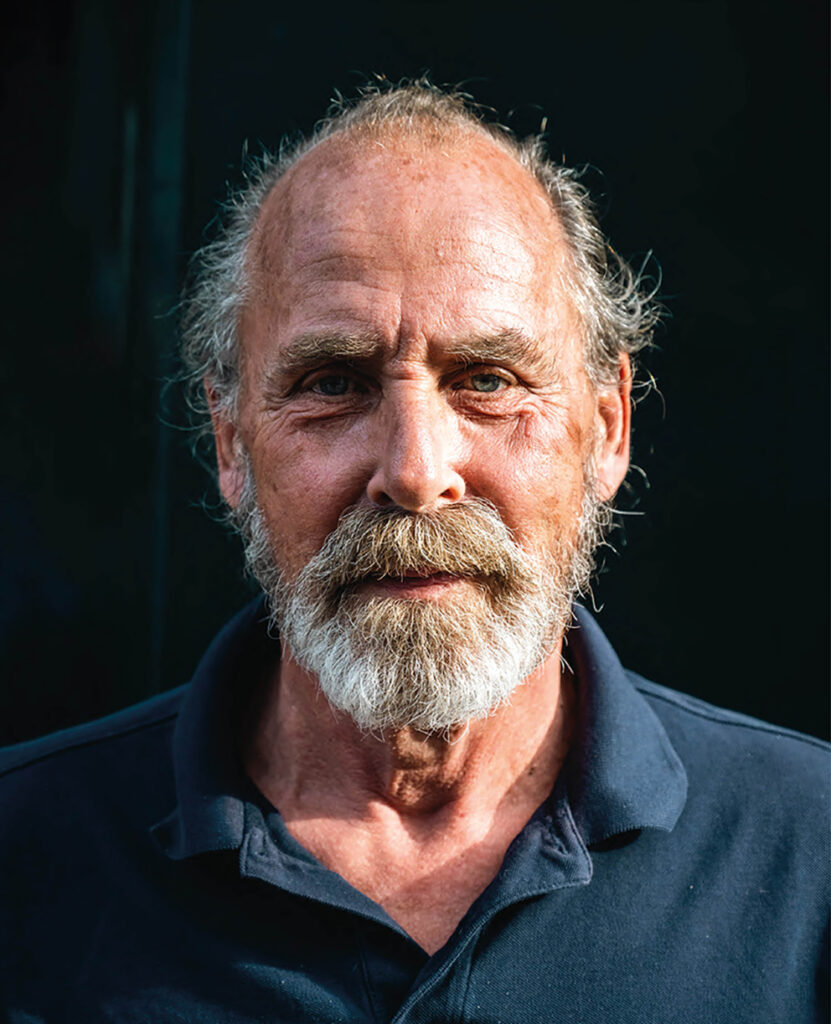
Images: 1) Keith Richards with grandma (in progress), 2) Zappa 70x145cm Victor Hoefnagels, 2025, 3) Keith Richards square, 4) Nina Simone 100x100cm Victor Hoefnagels, 2017 5) Elvis in the studio, 6) Cohen 70x145cm Victor Hoefnagels, 2025 7) Photo of Els by Patricia Steur, 8) Dylan 70x145cm Victor Hoefnagels, 2025 9) Victor Hoefnagels, 2025
https://www.victorhoefnagels.nl


Leave a Reply