


In the exhibition “DuO’s – Under the Spell of the Circle,” I saw fascinating combinations. Petra de Vree created a sculpture of a woman wearing a blue cloak and a beautiful headdress, and this sculpture was also featured in a landscape painting by Lynette de Vries.
I spoke to Petra at café-restaurant Vascobelo: “Lynette approached me about collaborating. It turned out we had something special in common: neither of us had lived in our own country for about 25 years. Lynette is from South Africa and lives in the Netherlands, while I am from the Netherlands and lived on three other continents for 25 years. Lynette showed me several photos of landscapes she felt homesick for. I picked this one out, not because I recognized her homesickness, but because this landscape held an adventure within it and captured my curiosity. (See image 2). What’s happening there, beyond the horizon of this rough sea?
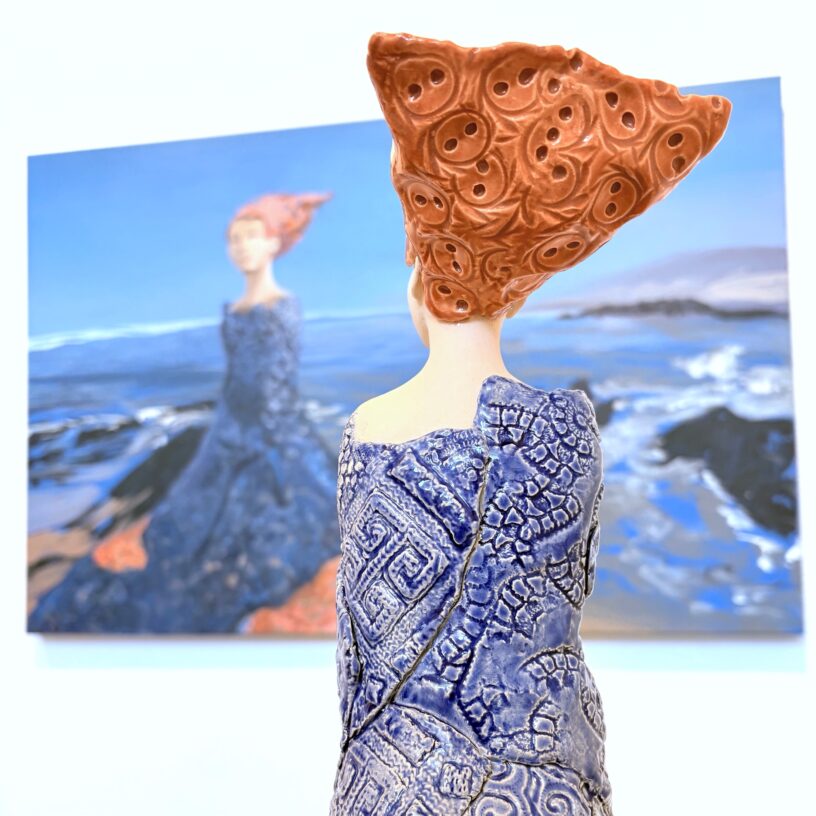
‘Beyond the Horizon’ became the title for our project. The statue directs its gaze toward its counterpart in the painting. This creates a compelling line: She looks at herself, and in the painting, she directs her gaze toward an infinity in the distance.”
Creative Hands
Petra’s sculpture depicts refined craftsmanship, skills from the past, and from the countries where Petra lived. Various patterns can be seen in the woman’s blue robe. “Many skills are lost with each generation,” she observes. “In the past, our grandmothers crocheted, embroidered, and made beautiful lace. That handicraft has long since been replaced by machines. I see the same thing happening in North Vietnam. Adult women diligently work on delicate traditional costumes, while young girls watch TikTok videos in the same village square. In China, the embroidery pattern is printed on synthetic fabric, which the girls buy at the market instead of embroidering themselves. About 100 years ago, my grandmother crocheted her bridal gloves; my daughter recently started knitting. In the sculpture, I express the passing of time with the buttons on the robe. They are both recent and old buttons, like those on my grandmother’s winter coat. The base of the sculpture is a print of her homemade glove.”

Six Months Away
The desire for a life outside the Netherlands began when Petra was able to take a six-month break during the third year of her art program. She went to Egypt, where she conducted a short research project for art history. She extended her trip by sailing south through Sudan along the Nile and visiting Uganda and Kenya overland. This trip changed her perspective on life and planted a seed of curiosity about other cultures. Her creativity was also sparked when she saw how people in Africa reused things and made cooking utensils and toys from old tin cans.
Deployed Together
After completing her studies, she taught Visual Arts for seven years. Her husband, who was also fond of traveling, was offered a job in Nepal. She left the schools in Arnhem, Zevenaar, and Nijmegen and embarked on a new adventure. Once in Kathmandu, she found a small wooden toy factory, where she began working as a designer. She drew inspiration from the city itself and transformed stupas and pagodas into children’s toys. She also learned to make handmade paper, designed cards, and was involved in women’s projects. Her interest in furniture making also found its place. Here, she discovered new materials. Petra: “I made my first light creations from metal and handmade paper. I continued doing this in other countries later.”

Bolivia
After two years, the couple moved to Bolivia. In Cochabamba, Petra opened a furniture store featuring her own designs. A blacksmith, carpenter, and shop assistant were permanently employed. “I saw their families flourish from the income they earned. The children received shoes and schoolbooks, and the men were able to afford better tools.” After four prosperous years, the situation changed due to a financial crisis in South America. They sought new prospects for themselves and their three-year-old daughter.
Ghana
Africa became the next destination, and Ghana proved to be a good market for her lighting fixtures. “Many houses only had a bare bulb. Even the presidential palace. When a new president took office, his interior designer commissioned me to create special lamps. The African context gave me new ideas. For example, I used Kente symbols in recycled paper and designed display cases made of the pestles women use to prepare food. When my husband once went to buy six pestles for me, he was treated with great respect. It turned out the market vendors thought he had six wives and bought a pestle for each one.” Years later, Petra created the key work ‘Ghanian Power’ out of respect for the country.

Guatemala
A new horizon beckoned after three years when her husband was able to find a job in Guatemala. “I wasn’t officially allowed to work there. It was a good time to further develop my creative talent. I took courses with renowned bronze casters and painters, had a studio at home where I focused entirely on light creations, and met other international artists to exhibit with. By chance, I came into contact with someone who worked with clay. And that whetted my appetite.”
Back to Bolivia
They moved to La Paz, and Petra quickly became part of the local art scene. An artist friend introduced her to Mario Sarabia, a renowned local ceramicist. In his workshop, she was able to work with clay. “A turning point; it felt like coming home.” One of her first sculptures was inspired by Marie Antoinette, with her enormous skirts. “The sculpture ‘Dance with Me’ was drying in Mario’s boiler room, where he accidentally hadn’t locked the door properly. That night, a dog chased a cat; they ran into the room. Everything there was in smithereens! Except for this sculpture. It had shifted slightly, but it was still there. Mario said, ‘That’s a sign,’ you have to keep making sculptures of women.” It became her first major key work.

Ode to Antoni
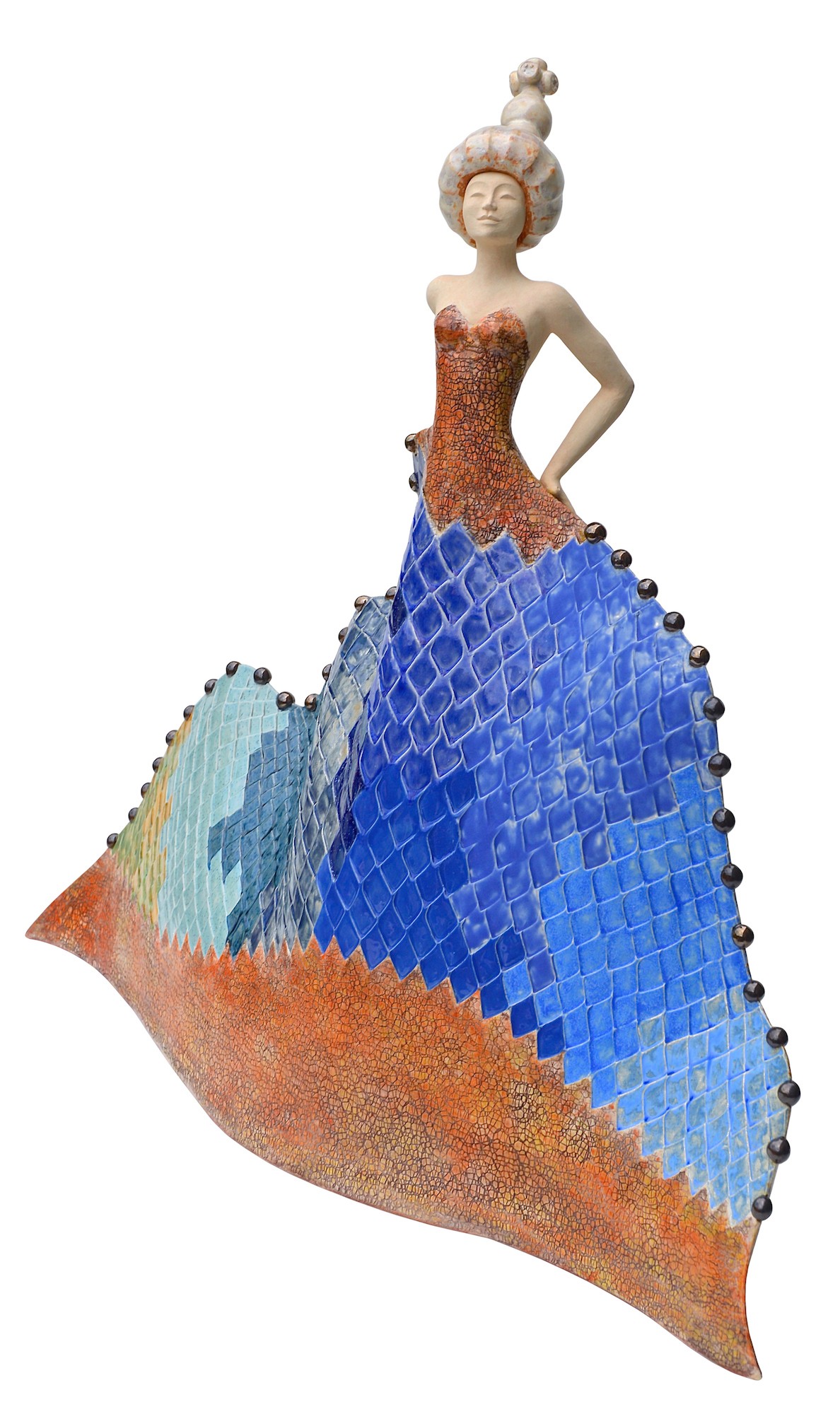
Another key work, ‘Ode to Antoni’, is inspired by the roof of Casa Batlló in Barcelona. “Just as Gaudí transformed the dragon’s back into a roof, I transformed the roof into a woman’s dress. The headdress is inspired by the chimney. I increasingly discovered the endless possibilities of clay, and my creativity materialized in dozens of female sculptures. The fact that so many people feel inspired by my work acts like a relentless motor.”
Bangladesh
After their daughter finished high school in the Netherlands, a foreign country beckoned again, and she traveled to Bangladesh with her husband. During these three years, she continued her work and began a series based on the fertility of the vast delta that is Bangladesh. At the same time, she expressed a freedom not generally found elsewhere in the world. She became fascinated by the enormous variety of coarse and fine handicrafts in the country, from hand-making bricks to weaving exquisite fabrics with gold thread. This would later become a theme in her work.
Vietnam
Because all the work from Bangladesh had been sold, she started with a clean slate in Hanoi. The style changed, the faces became more detailed, and the arms disappeared. Beautiful dragon mountains from Ha Long Bay became her first source of inspiration, and sculptures of ‘human rocks’ were subsequently created from various types of clay. Vietnam’s national flower, the lotus, became another source of inspiration. This beautiful flower originates in the muddy mud, just as her female sculptures are made from simple clay. Meanwhile, she continued selling to locals and expats. “As a result, my sculptures can be found all over the world, from Canada to Japan, from Norway to Australia. I find that a beautiful, unifying thought.”

Now back in The Hague
After five years in Vietnam, Petra traded the skyline of skyscrapers for the flat Netherlands and the vast sea. Sea Watches Back is a beautiful representation of that.
Why are the images of women so important to her?
“As a girl, different things were expected of me than of my brothers. It gave me a feeling of unfairness from a young age; for example, I was happy to do the dishes, but then they had to do them too. We still haven’t found the equality I was looking for back then in the Netherlands. That’s why it remains relevant to show female strength.”

How long has she been an artist?
“From a young age, I loved to draw; I always wanted to make things by hand. When I was 10, I went to my father’s workshop to make a wooden fork with the grinding machine. He let me. At that time, drawing and handicrafts were my favorite subjects. It was only logical for me to want to go to art school. I chose TeHaTex in Nijmegen, which also gave me a teaching qualification and allowed me to earn a living.”
What’s her experience with the art world?
“The most beautiful life, it makes me very happy. It’s not the easiest; you need a cycle of creating and selling, and the latter can be tricky. Moving so often meant I had to start over repeatedly, especially after achieving fame in my previous country. That takes a lot of time and energy. But I honestly couldn’t have wished for any other life!”
Finally, what is her artistic philosophy?
“Creating a sculpture is like a journey of self-discovery. Just like traveling, I want to broaden my horizons. At the start, I have a pack of clay and some tools. But the sculpture creates itself; there’s no plan; it evolves gradually, intuitively, playfully, experimentally, and with enjoyment. I want to surprise both myself and the viewer by creating something that didn’t exist before. Just as every person is different and every woman unique, I want to give each of my creations its own personality.”

Images
1) Blue Lotus, 2) Beyond the Horizon, 3) Language in Texture, 4) Not Afraid of Using Tools, 5) Ghanian Power, 6) Dance With Me, 7) Ode to Antoni, 8) Serenity, 9) Sea Watches Back, 10) Portrait photo Petra de Vree
https://www.petradevree.nl/
https://www.instagram.com/petradevree/
https://www.facebook.com/artistpetradevree/
https://www.linkedin.com/in/petra-de-vree-89933a10/
https://inzaken.eu/index.php/2025/08/27/de-vrouwenbeelden-van-petra-de-vree/


1 Pingback