
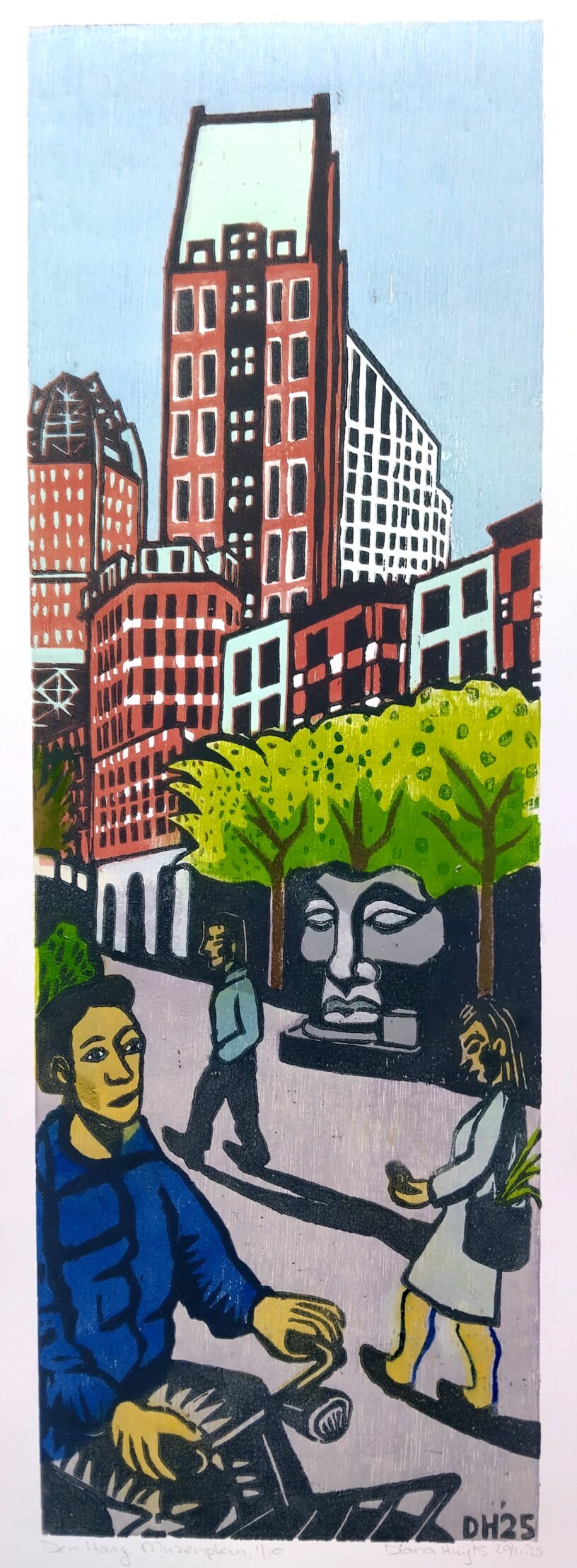


Pulchri’s recent graphic exhibition featured beautiful prints by Diana Huijts. They included four elongated prints of modern The Hague, with the tall towers near Central Station, as well as one of the sea and the beach and dunes in front of it.
Diana Huijts regularly visits The Hague because her children live there, she tells me in Pulchri’s clubhouse and café/restaurant. “I used to think of The Hague as the city of Couperus and the Hague School, but I soon had to revise that idea: it turned out to be a city with a dazzling skyline of modern high-rises.”

Japanese art
The format of the prints was inspired by Japanese art. Hashira-e is a term in 18th-century Japanese printmaking. “It literally means pillar print. It has a vertical format of approximately 73 x 13 cm and was originally intended to decorate the pillars in houses.” The format offers unprecedented expressive possibilities. “The seemingly impossible long-narrow ratio creates a very dynamic space.”
Between 2009 and 2011, she created a series of 36 prints; linocut/stencil prints, each depicting the Alpha Tower, the skyscraper and highest point of Enschede, the city where she lives. “I admire the prints of Hokusai and Hiroshige (19th century), among others. Hokusai created 36 Views of Mount Fuji; 36 visions of the mountain, each from a different perspective. Following his example, I decided to create 36 Views of the Alpha Tower; 36 scenes from daily life in and around Enschede, with the tower as their leitmotiv. In a portrait A3 format.”
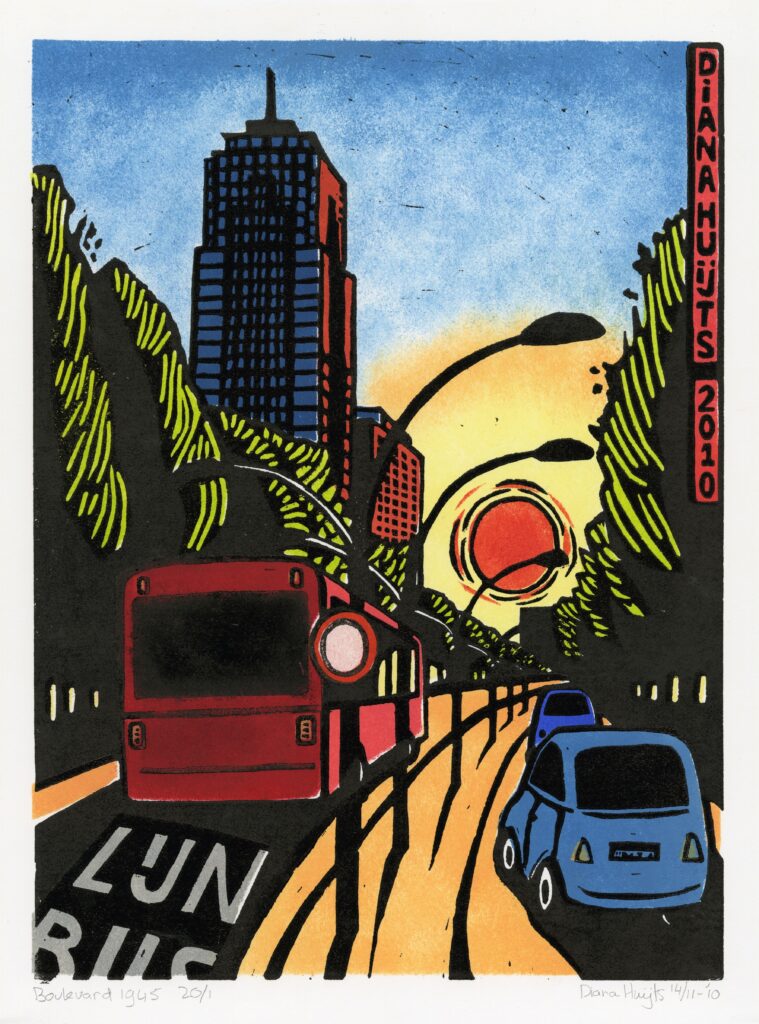
In 2019-2020, she created a series of 17 x 60 cm woodcuts of the Aamsveen, a nature reserve near where she lives, and of the Botanischer Garten in Münster. The prints of The Hague also have this elongated, vertical format.
Nijmegen Prints
In 2017, she received a commission from the Intermedi-Art gallery in Nijmegen. This gallery and art lending center annually commissioned an artist to create the Nijmegen Print. Diana received this commission for the 2018 Nijmegen Print. She herself proposed creating twelve views of the Waal River near Nijmegen. The gallery owners enthusiastically received this idea, and the plan was born to let the readers of De Gelderlander choose which of the twelve prints would be included in the 2018 Nijmegen Print.

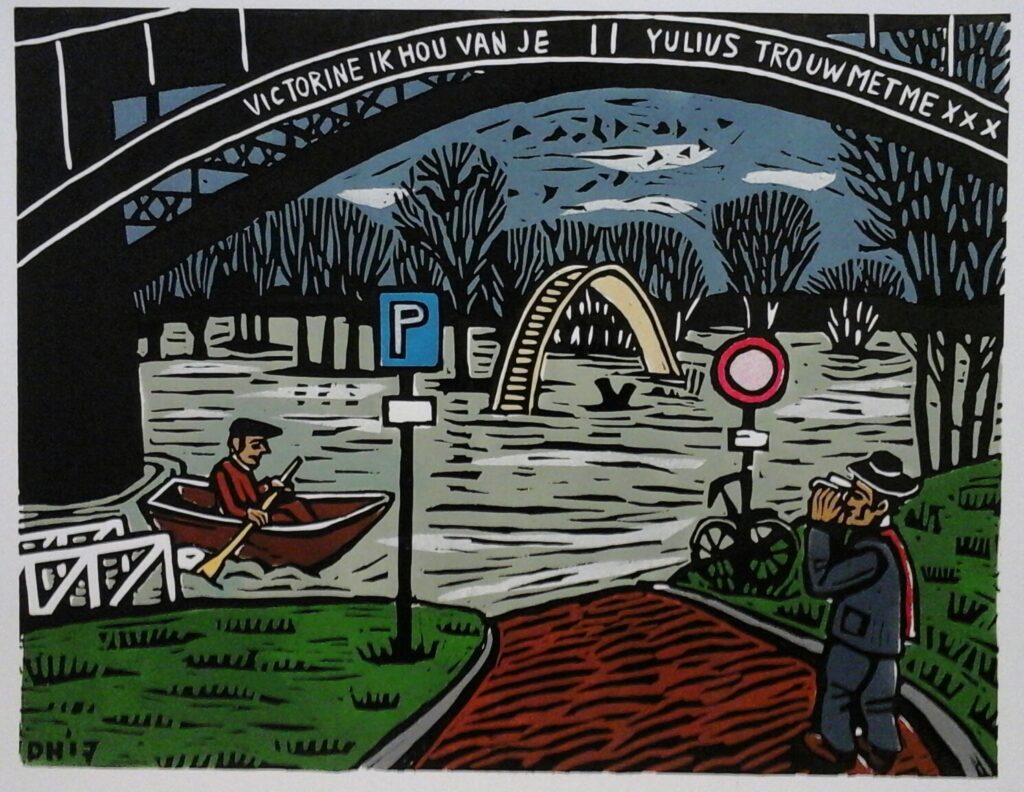
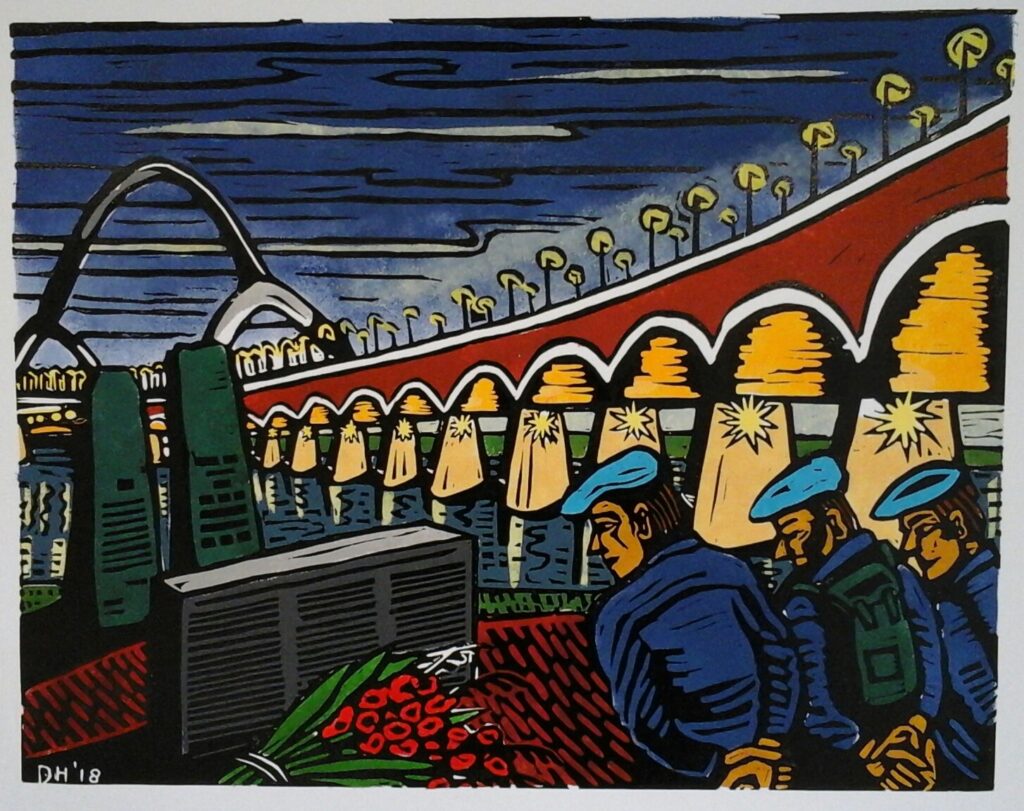
“The people at Intermedi-Art were wonderful clients. They guided me through Nijmegen for a few days. That’s how I found subjects for my prints. Like the soldiers who laid flowers every evening at the Waal Crossing war memorial, the rowers on the Spiegelwaal, and the Waal Bridge during high tide with the words ‘Victorine, I love you // Yulius, Marry me XXX’ written in bold white capital letters on the arch. The text was later removed; Victorine and Yulius had broken up by then. Eventually, I had all 12 Views of the Waal River near Nijmegen. The readers of De Gelderlander chose View of the Waal Quay and the Valkhof Chapel. That became the 2018 Nijmegen Print. The entire series was exhibited in the chapel of the Stevenskerk during the Four Days Marches.”
Cartoons
Between 2004 and 2010, Diana created cartoons for Roskam, a Twente opinion weekly. Political issues like Twente Airport were addressed in ‘Airport for the Birds’, Jan-Peter Balkende as a flying ghost above the Twente town of Rijssen in the story ‘The Great Event’ by Belcampo, or ‘Fries Eaters Christmas’ (based on Vincent van Gogh) and ‘No Shortage of Customers at This Bank’ about the Food Bank. “The themes of my prints were the often abrasive social conditions. Sources of inspiration: serial, sometimes cartoonish graphics by artists like Goya (Los Caprichos), Otto Dix (Der Krieg), George Grosz (Ecce Homo), and Rembrandt. His etching ‘The Flight into Egypt’, featuring Joseph, Mary, Jesus, and the donkey fleeing, has acquired a gruesomely topical charge in recent decades. I used that image for a print.”

Sakhalin
Currently (February–April 2026), she has an exhibition at SchouwArt, the gallery in the Hengelo Theatre, featuring 16 woodcuts and 20 painted canvases inspired by Anton Chekhov’s book ‘The Journey to Sakhalin’. “I read the book in 2014. It made a deep impression on me. Chekhov’s work consists mainly of stories and plays; this book is atypical of his work.”
In 1890, when Chekhov was 30, he decided to travel to Sakhalin to investigate and write about the penal camps from the Tsarist era. “The island lies above and in line with Japan. Chekhov traveled through Siberia for three months, alternating between boat and stagecoach. After a short boat trip, he reached Alexandrovsk, the capital of Sakhalin. There, the prisoners were held; both criminals and political prisoners, often accompanied by their wives and children. The prisoners were put to work in a coal mine.
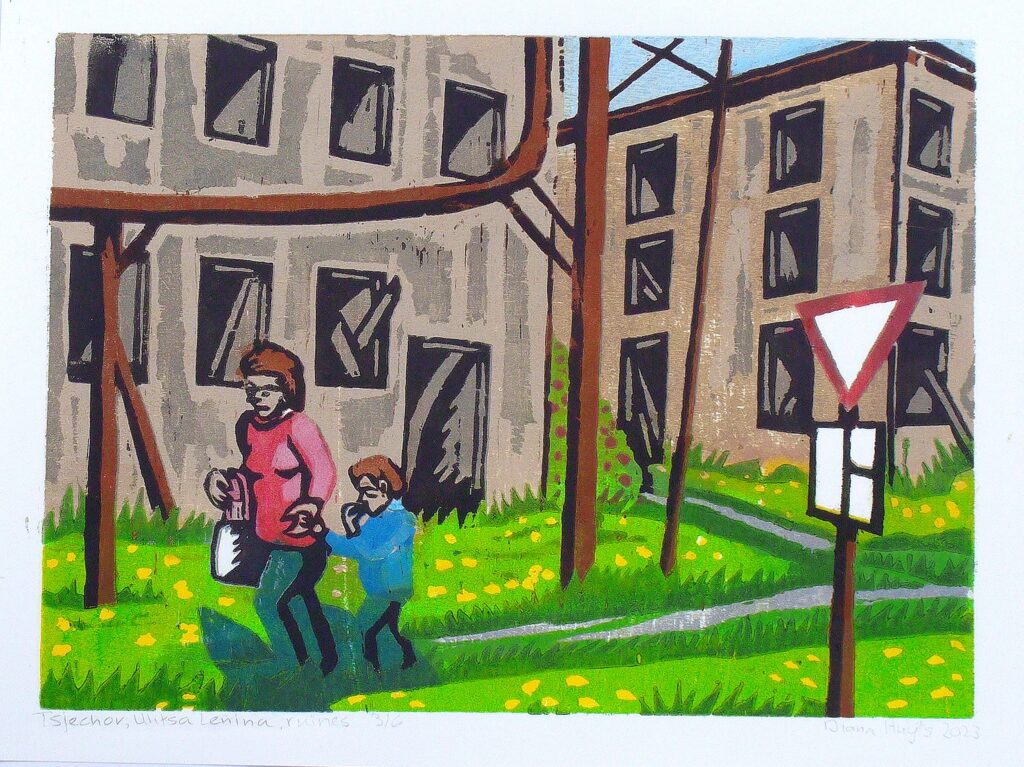
Chekhov was a physician. He wrote with horror about a torture he witnessed and the appalling treatment of women and children. His book was one long indictment. At the same time, he wanted to approach his research scientifically. He kept 10,000 cards of his conversations with the locals. He contacted everyone: the original inhabitants, the Ainu people, the prisoners, the guards, the women, and children. These cards are stored in the Lenin Library in Moscow. “
Google Earth
After reading the book, Diana consulted Google Earth to see if any of the locations from Chekhov’s book could still be found. Taking a chance, she landed in the port of Alexandrovsk, where Chekhov and all the convicts and their entourage first set foot on the island.
“Near the bay in front of the harbor, there are still shipwrecks like those Chekhov described. And soon I found the house where he lived. He described the rattling of the shackles as the chained prisoners walked by and the noisy marching music from the soldiers’ barracks across the street as they rehearsed.”
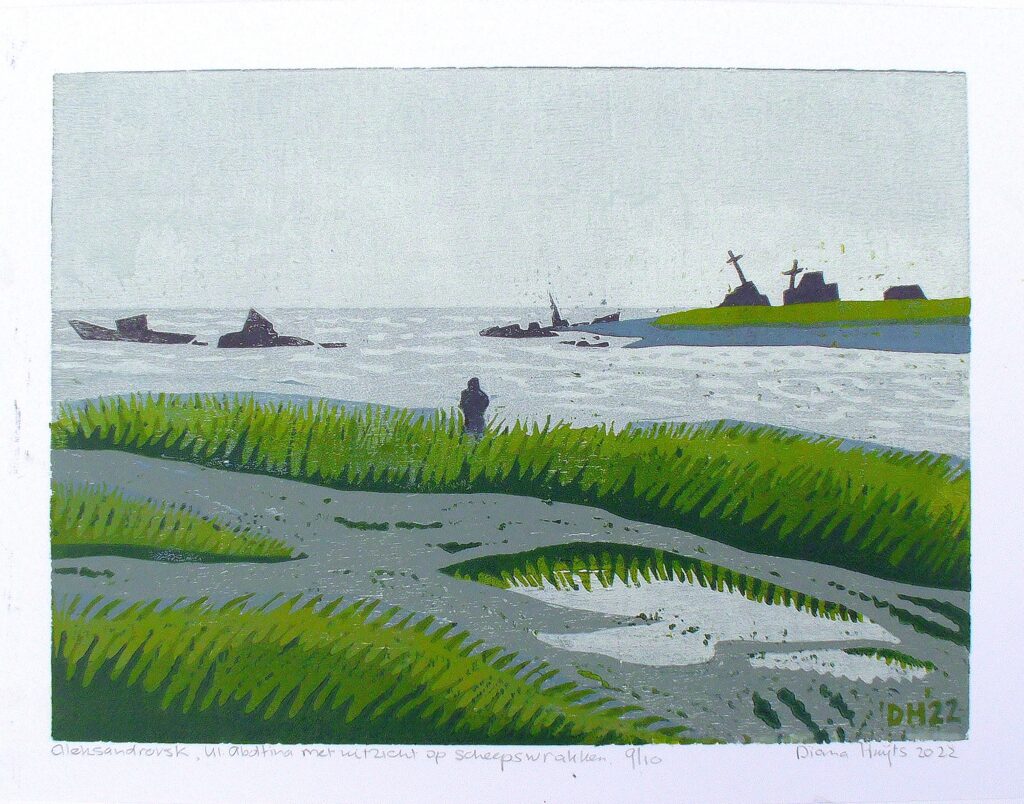
“But I was increasingly struck by the bleak misery of 21st-century Google Earth images; everywhere on Sakhalin, the remnants of the Soviet era are visible, with dilapidated apartment buildings, ruins, rusty gas pipes, and strands of electrical cables. You see stray dogs wandering around and children playing in the rubble; presumably descendants of the prisoners Chekhov described.
After the Tsarist-era katorga camps came Stalin’s Gulag camps. He wanted to build a tunnel between Sakhalin and the mainland. This megalomaniac project was carried out using tens of thousands of Gulag forced laborers, but was immediately halted after Stalin’s death in 1953. The unfinished project became a notorious ‘dolgostro’ (long-term unfinished construction).
Factory ruins, ghost buildings, impassable roads—you see them everywhere on Google Earth’s Sakhalin. Except near major oil and gas projects. There, resorts with ski slopes are springing up for expats and tourists.”
In the publication ‘Sakhalin, a Virtual Journey’, Diana recounts her quest and explains the project she has been working on intermittently since 2015. The publication includes a selection of the 16 woodcuts and 20 canvases on display at the exhibition at SchouwArt Hengelo. Ricardo Liong-A-Kong designed the publication. The publication can be ordered via the website: https://dianahuijts.weebly.com/
How long has she been an artist?
“From ’78 to ’83, I attended the AKI in Enschede, so 43 years. I designed book covers and illustrations and lived from commissions and the sale of my work; graphics and paintings. I also taught drawing, painting, and graphic techniques at various schools and cultural institutions. From ’87, after the birth of my youngest son, I got a larger studio with a printing press.”
What is her experience of the art world?
“I occasionally enjoy collaborating on collaborative projects with fellow artists, for example, to create a portfolio of prints or a publication. But ultimately, I’m too much of a solitary person to collaborate for very long and intensively.”
Finally, what is her philosophy?
“In my work, I capture everyday life and try to understand it.”

Images: 1) The Hague Muzenplein, 2) beach at Scheveningen, 3) View from the Boulevard 1945 at sunset, 4) View of the Waalkade and the Valkhof Chapel, 5) View from under the Waal Bridge at high tide, Nijmegen, 6) The Great Event, 7) Chekhov, the town of Ulitsa Lenina, 8) Aleksandrovsk, ul aboltina, 9) Nijmegen, view of the bridge The Crossing (De oversteek), 10) portrait of Diana Huijts at work
Current exhibition
Diana Huijts, Sakhalin, a virtual journey: January 31 – April 5, 2026
Schouwburg Hengelo, Beursstraat 44, 7551 HV Hengelo
https://dianahuijts.weebly.com
https://www.facebook.com/diana.huijts/?locale=nl_NL
https://www.pulchri.nl/nl/tentoonstellingen/het-grafiekplatform-in-pulchri-studio/
https://www.kunstmagazijn.nl/
https://www.grafiknetzwerk.eu/netzwerk/6-kunstler-in/49-Diana-Huijts
https://www.grafiekplatform.nl/leden/grafici/diana-huijts/
https://inzaken.eu/index.php/2026/02/10/langgerekte-prenten-van-den-haag-door-diana-huijts/


Leave a Reply