


I visited the exhibition ‘Where is your humanity’ at Het Archief in Rotterdam. The exhibition brought together personal and collective stories surrounding the ongoing genocide of the Palestinian population in Gaza. A week later, I spoke with two of the artists, Diana Roig and Randa Nassar, about the exhibition. Below is the conversation with Randa Nassar.

Randa Nassar is a filmmaker. She came up with the idea for this exhibition.
Randa: “During the genocide, I collected images and stories of my family in Gaza. I did this fully aware that not only lives were being destroyed, but also personal memories, family histories, and an entire culture. What is disappearing is the proof that we once existed.”
She quotes the Palestinian poet who wrote: “Exile is more than a geographical concept. You can be an exile in your homeland, in your own house, in a room.”

Protecting what threatens to disappear
As a filmmaker, she entered a new domain. “That transition felt natural. The need to capture, preserve, and make visible was stronger than the form. This work stemmed from the instinct to protect what threatens to disappear.”
Creating these works was a form of therapy, but above all, they carry with them the constant threat and fear of not being allowed to exist. They speak of an identity that is intentionally and systematically erased. “Of a life in constant uncertainty, where even memories are not safe.”
She is Palestinian, she says. “I am all too aware that you are not actually allowed to exist as a human being, in my own country, and in the Western world. That is how you are treated. My right to exist is important, that is why I chose this subject. ‘I exist, I am simply here.’”
Film Academy in Brussels
Randa studied film at the Sint-Lukas Film Academy in Brussels, and before that, Art and Culture, Media and Communication at the Rotterdam University of Applied Sciences.
She has made and produced films for many years. In addition to screenwriting for film, she subsequently started writing scripts for the theatre. She has now been nominated for the Roosendaal Culture Prize for a project for primary school children in which she linked stories she had recorded from children in Gaza—many of them great-nephews and great-nieces—to the theme of children’s rights. The pilot took place at a school in Roosendaal, and she is currently organizing a tour in the Netherlands for the project.
A way of processing
She has lost two-thirds of her family in Gaza, she says. “I needed to get this off my chest. This project and this exhibition is a way of processing.”
In early October 2024, she called Marieke van der Lippe, whom she knew from Off-Screen. Marieke van der Lippe suggested the idea of giving a lecture-performance and invited her to Off-Screen. She did so in late 2024.
In that year, Randa collected many images of her family from Gaza and developed her artworks. Then she came up with the idea to turn these works into an exhibition. She called Marieke van der Lippe to ask if she wanted to help her with this.
She had already seen a few films, including ‘The Elephant & The Room’, about what happens when people flee, using the elephant as an example; a film by Dina Naser, ‘One Minute’, about the one minute the IDF (Israel Defence Forces) gives Palestinians to leave their homes before they are bombed; and a film by Randa’s mother, ‘In Exile’, about the Nakba and what freedom means to her in the Netherlands.
A tour of the exhibition
I take a tour with Randa of the exhibition on the ground floor.
The first work lies on the floor and shows a hilly landscape of yellow river sand in which I recognize the borders of Israel, including the West Bank. In one place, it is flat: that is the Gaza area. The title is ‘Not a Genocide’. Randa: “We see the map of Palestine here. This map represents the erasure and displacement of Palestinian identity. The flat piece of Gaza is now literally being bombed completely flat and has become a chaotic plain. The original identity is now being wiped away and prepared to—just like the other parts of Palestine—acquire a new identity through colonization. What is happening in Gaza is now also happening in the West Bank.”
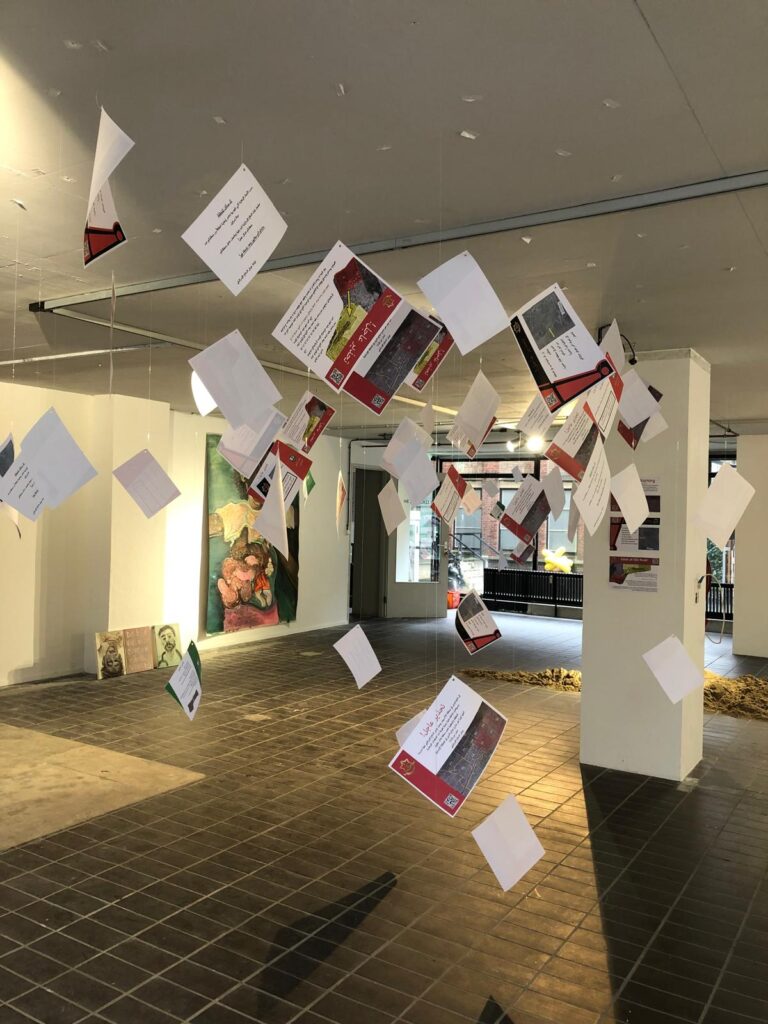
We are going to the work ‘Paper-Storm’, a whole lot of flyers hanging from wires in the ceiling. The text is in Arabic. The flyers were dropped from IDF planes and from drones. Various zones are marked on them, such as E2, D5, etc., threatening people with a move from one zone to another. “As a result, people are constantly forced to flee due to the fear of being bombed. This shows that they are continuously trying to seize land and strip the original environment of Palestinian identity.”
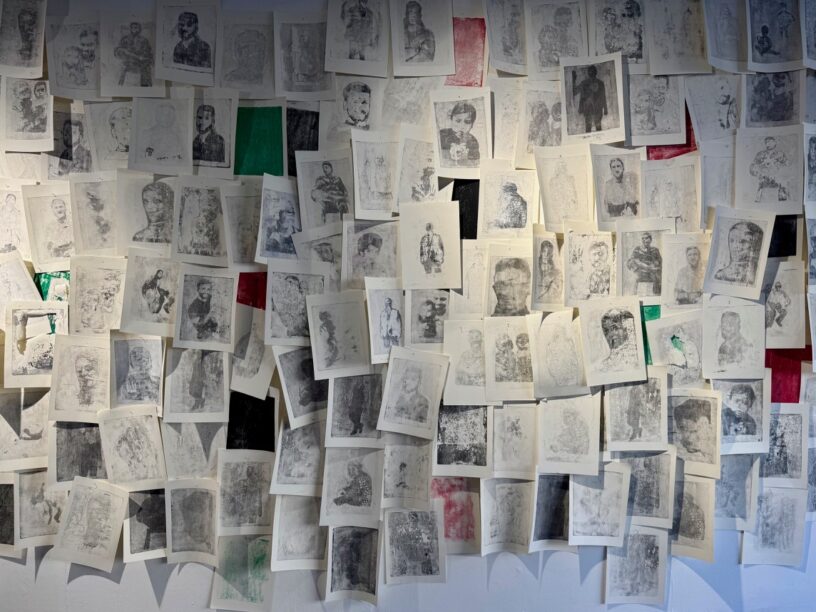
On one wall, ‘200 & counting’ is displayed with the ‘Martyrs’ Wall’. Dozens of prints of photos of 15 of Randa’s family members. Those family members are no longer alive. “Some even evaporated, completely vanished into thin air. Their belongings, their photo albums for example, disappeared along with them.” She has edited existing photos using jelly print, with black and white acrylic paint. It has been captured on sturdy bamboo paper. Around the corner, a print in red is visible; it is an image of a great-niece when she was young. She and her entire family perished. Hence the color red.
SoundScape of War
In a dark room, we see lights flickering against the wall and hear sounds of war, titled ‘SoundScape of War’. You hear the sounds in the night, the buzzing of drones and the occasional bang. Something lights up on the screen from time to time. “The sounds were recorded at night in Gaza. I edited it into 10-minute segments. What you see against the wall are the lights of ambulances or the fire of weapons. You have to imagine what it is like to hear this every night in your makeshift tent.”
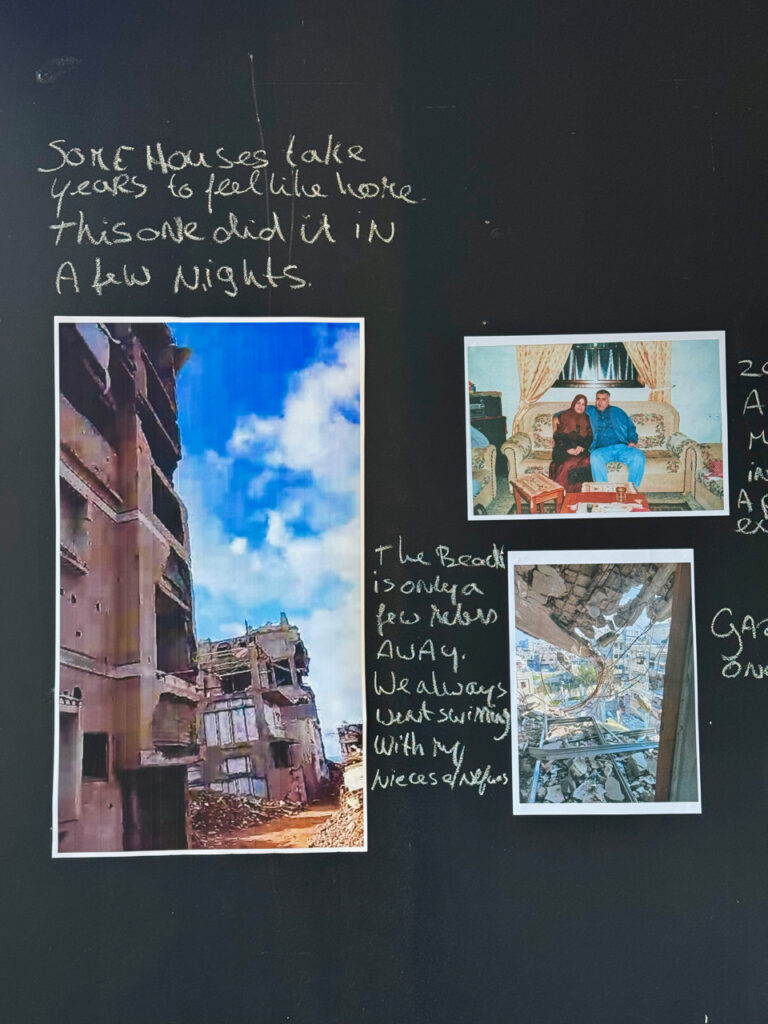
In the next section, ‘Ruins of Homes’, we see her aunt’s house, to which she has many memories. The photos are from when she was 14. We see her sisters, cousins, and niece on the sofa in the guest room. The house is gone. “A nice and lovely house.” Below it is her uncle’s house, near the beach. This house felt like home, she says. The house still stands there rickety and is severely damaged, with several open holes.
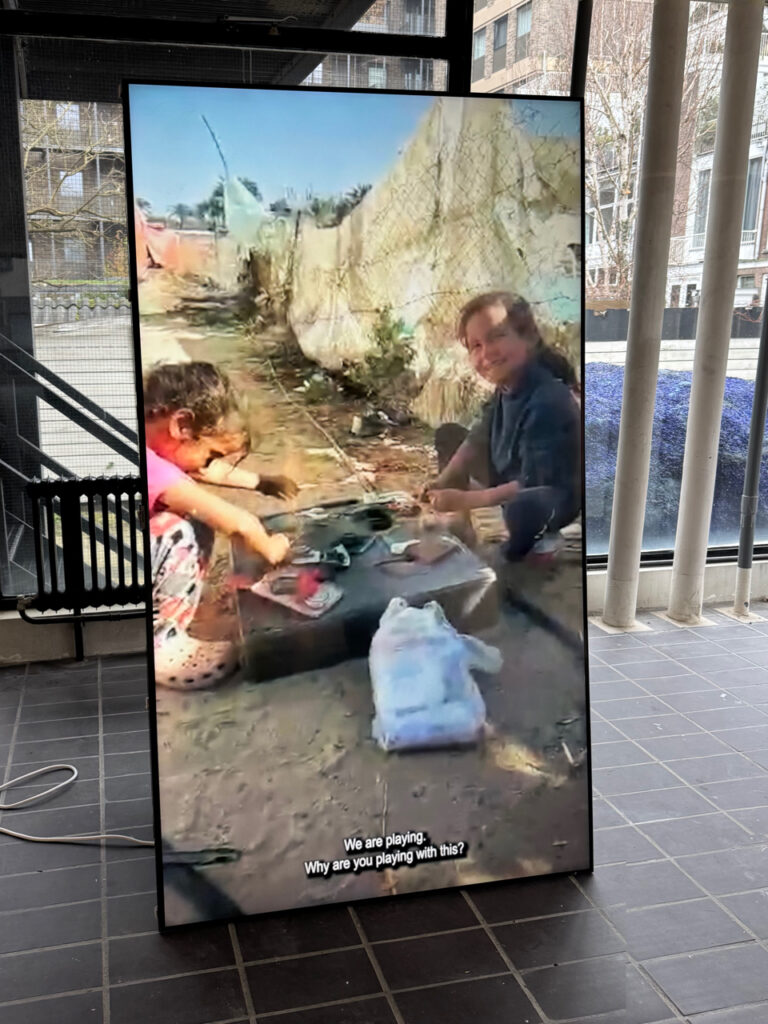
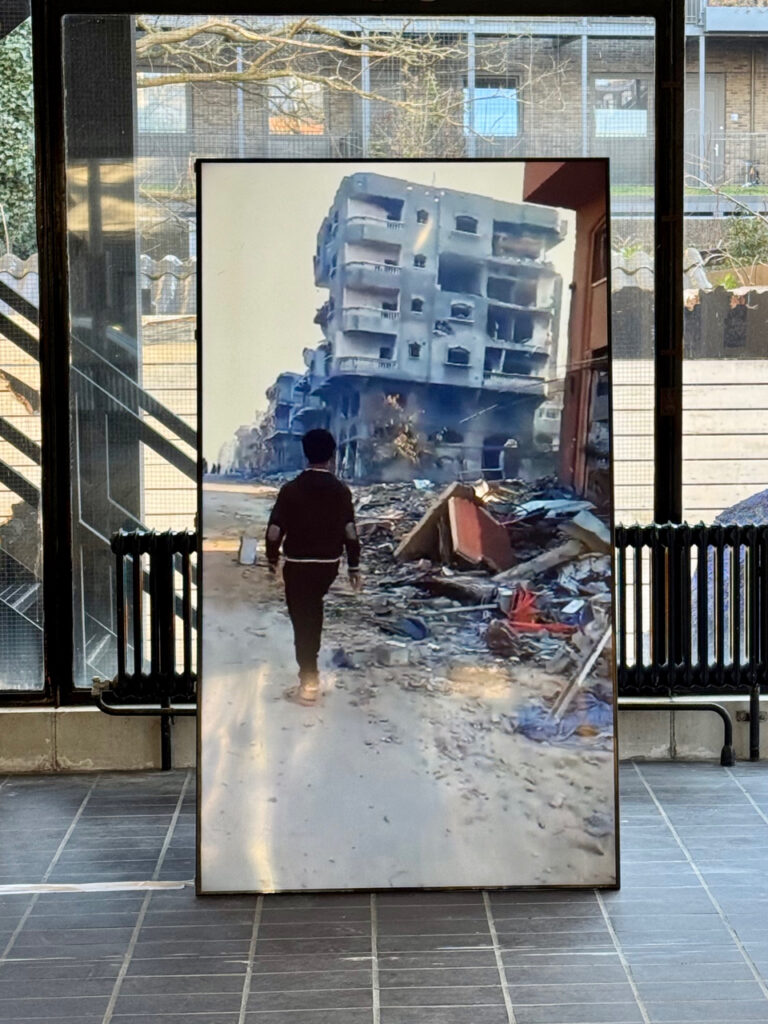
On a large screen, the film ‘Fragments of Survival’, a 20-minute triptych. In part 1, we see the second refugee camp in the south of Gaza where her uncle stayed; all the tents and all the people are crammed together. Part 2, ‘Daily Tasks’, features video footage of the tent where her uncle lives, fetching water and baking bread. Part 3, ‘Going back Home’. After permission is granted to return to the North, her uncle and his sons do so, but a week later than the others. On foot. “They judged the risk too great to go immediately. The camera follows them the whole way.”
It is a very personal story, the story of her family and her identity. She quotes Omar Al Akkad, a Palestinian living in America who wrote:
“One day, when it is safe, when there is no longer any personal disadvantage to calling things as they are, when it is too late to hold anyone accountable, everyone will have always been against this.”
What is your experience with the art/film scene so far?
“It is a strange world; with Palestinian stories, you get censored, ‘told too Arabicly.’ Or they want ‘the white gaze’ cast over it. I find that difficult. You have to maintain your individuality. Art must also be able to be uncomfortable.”
Finally, what is her artistic philosophy?
Randa: “Art must be able to be activist and must not be censored. It is definitely allowed to have color. I take a stand to make people think. It is time for the Western world to learn to understand our stories as well.”
Images: 1) ‘200 & counting’, 2) Soundscape of War, 3) Not a Genocide, 4) Paper-Storm, 5) Ruins of Homes, 6) Fragments of Survival 1, 7) Fragments of Survival 2.
Photos taken by Marieke van der Lippe, photo 4 taken by Randa Nassar.
https://hetarchiefartspace.com/
https://www.instagram.com/nourpicturesofficial/
https://cultuurverbindtroosendaal.nl/projecten/de-kindermonologen/
https://www.instagram.com/p/DT-nu7RDFf4/
https://www.imdb.com/name/nm5946875
https://inzaken.eu/index.php/2026/03/10/een-gesprek-met-randa-nassar-over-de-tentoonstelling-where-is-your-humanity/


Leave a Reply