


An exhibition of the work of Amsterdam street photographer Michael van Oostende is currently on display at the ‘Bon Aire’ general practice in De Baarsjes. The photos can be viewed both outside, in the window panes, and inside, in the waiting room.
I run into him at the opening of the exhibition. I had already been leafing through his most recent photo book Vondelpark Seasons (2024), with beautiful photos of the park in four seasons.

Vondelpark
In striking photographs, he showcases the beauty and allure of the Netherlands’ most famous park, including the park’s interaction with its visitors, ranging from the ordinary to flamboyant. This results in a complete visual narrative in which the different colors of the seasons reappear: from light green to dark green, from pink to red, from red to deep red purple, and finally brown and gray. To start the following year with renewed vigor. The book is an ode to the Vondelpark and the freedom in which ten million visitors per year revel.
A week later, I speak to him at length in the café of the Public Library in De Hallen. He has brought his camera, a Canon with a large close-up lens.

How it began
He talks about how it started. “I worked as a taxi driver in Amsterdam. In ’86, a colleague told me he had a darkroom for sale. I was 26 at the time; that really hit me—‘a complete darkroom.’ I didn’t have to think long; I took that darkroom off his hands. I was already taking photos, but not very seriously. I went to the public library to read about how to set up such a darkroom. I had an attic room at my disposal. I installed a developing tray, a fixing tray, and a stop bath. I put the enlarged negative into the tray, exposed it, and then my first photo appeared on paper. Everything in black and white. It was magical. Time flew by. Incidentally, it is making a complete comeback. More and more young people are discovering the darkroom.”
He sold his darkroom a few years ago. “Around the year 2000, I switched to digital. It has now become completely digital.”

Out and about every day
He went out every day. “I started street photography right away. I often hung out around Dam Square; every provincial goes crazy on Dam Square. And I was on the Zeedijk and along the canals. Nothing really interesting happens on Leidseplein. I also go to East or Nieuw-West sometimes; you can see something surprising, but it’s nothing special. The place is the Vondelpark. “I always enjoyed walking around there and taking the necessary photos. But I didn’t have any real inspiration. Until I thought: ‘I’m going to photograph the four seasons in the park.’ Resulting in the book Seasons.”

People person
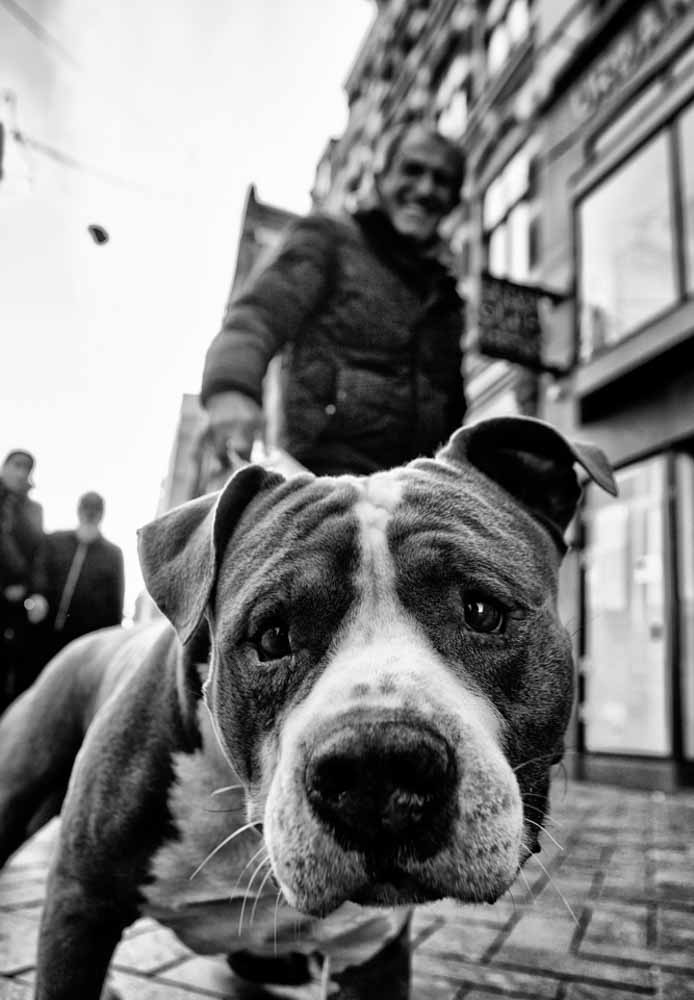
He is a people person, he says. “I like photographing people. But also things; however, I see things differently, I see things that someone normally walks past. A trash can with an advertisement for Bar-le-Duc, pure spring water. I see it on the spot and I click. That is called ‘looking with a photographic eye’. It is looking at the details.”
We look at a photo of a trendy young lady, pink hair, black winter boots, blue wide trousers and a green coat with headphones, a cup of coffee in her hand. She is standing on the traffic island next to the tram tracks near the Spui. “She walked from left to right. We didn’t make eye contact. She turned a quarter turn. I clicked. And then she walked on.”
And a photo of an Amsterdam bridge with three round passages in the early morning. A pedestrian walks across the bridge. The trees and the canal houses are reflected in the water. The morning is shrouded in orange and blue. “It was an early morning, my hands were cold. I wanted to set the camera, but I couldn’t manage it. By chance, I got the right direction.”

Photography is also poetry
He attended the IVKO (Individualized Advanced Artistic Education). “We had expressive arts subjects: dance, drawing, painting, spatial art. There was an abandoned darkroom, but no teacher, so it was used for completely different things. Creativity was and is a driving force. I wrote poems, and in a sense, I still do, because photography is also poetry.”

Who are his heroes in the field of photography?
“Good photographers: Robin de Puy, Eddy Wessels is also good. My great hero is Vivian Maier. She was a street photographer in the 50s and 60s. First in New York, then in Chicago. She never developed her film rolls. They were discovered by chance. She had an extraordinarily good eye for photography.”
Besides his book about the Vondelpark, his book Street Photography Amsterdam, featuring unique photos of the city of Amsterdam and its inhabitants, was published a year earlier, in 2023.
When asked who is the best street photographer after Ed van der Elsken, he answers resolutely: “I am.” A booming laugh follows.

Besides at the Doctors in de Baarsjes, he has exhibited at Cultural Center de Balie and in the NDSM-loods.
Michael no longer sells photo prints, but photo files. You receive an original file, with a certificate of authenticity, date, and signature.
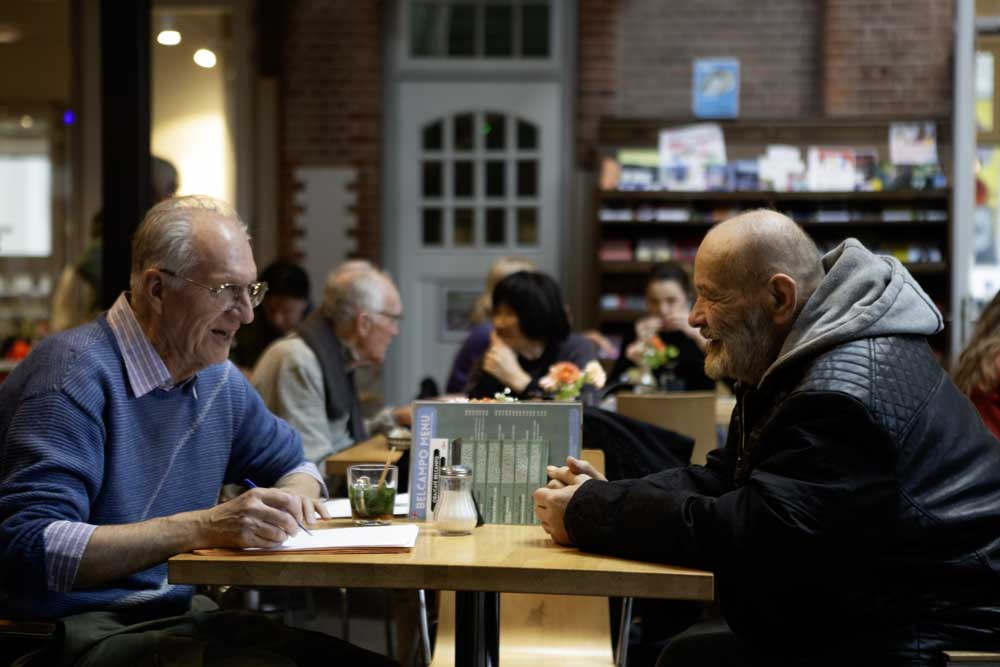
Finally, what is his philosophy?
Michael: “Street photography is a discipline of its own. You need patience and a good eye. In addition, a sense of composition. That certainly applies to my portraits on the street as well.”
https://www.streetphotographyamsterdam.com/
https://www.instagram.com/michaellvanoostende/
https://mlbgalerie.nl/mlb-bij-de-dokters-michael-van-oostende/
https://inzaken.eu/index.php/2026/04/10/michael-van-oostende-fotografie-is-ook-poezie/


Leave a Reply