
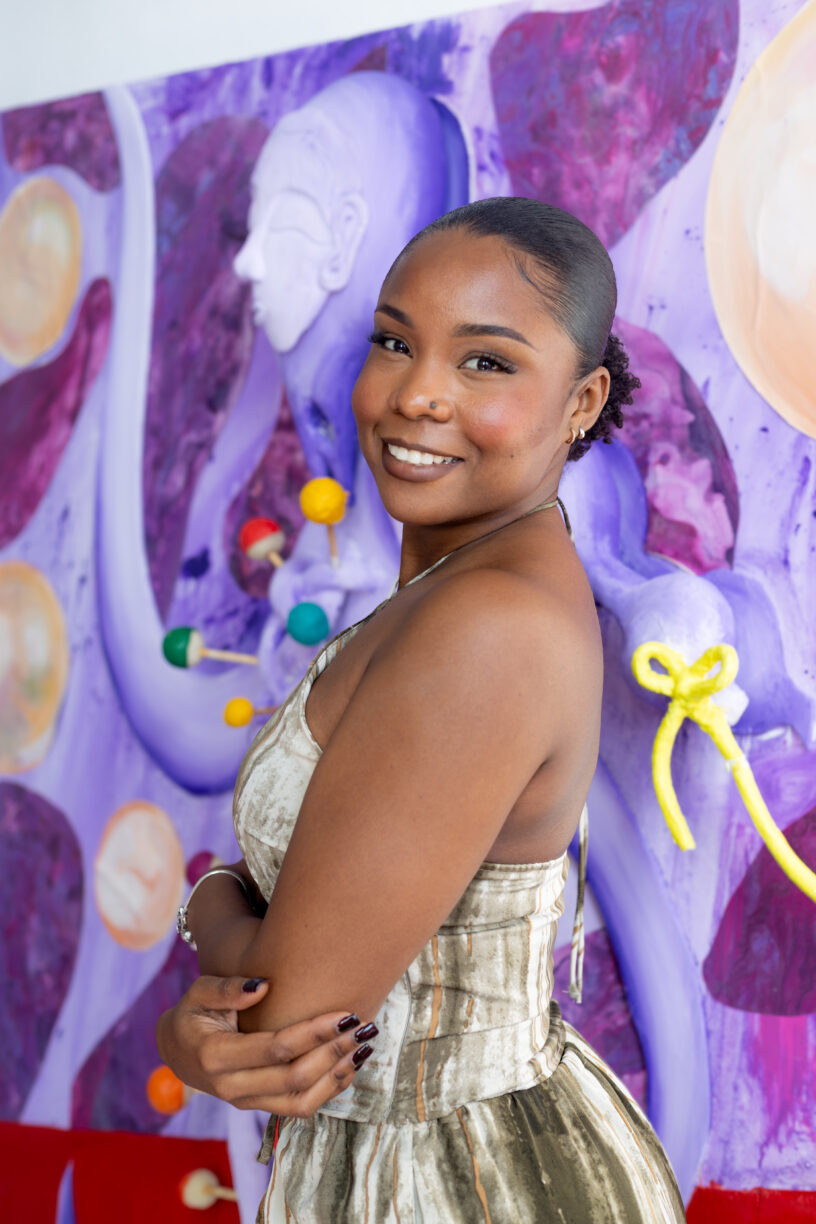
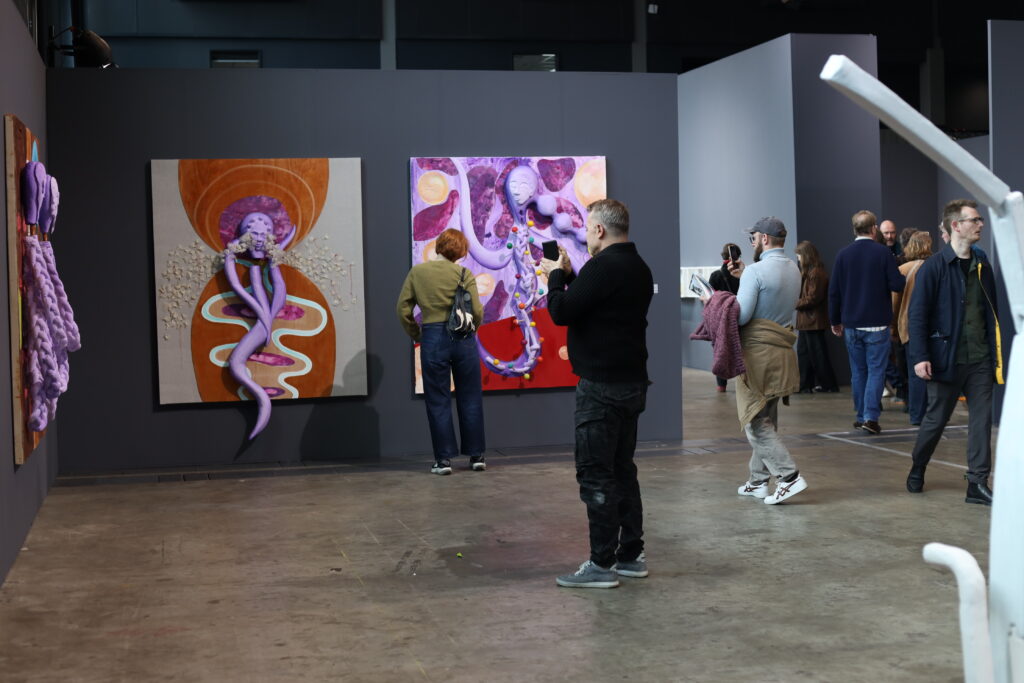
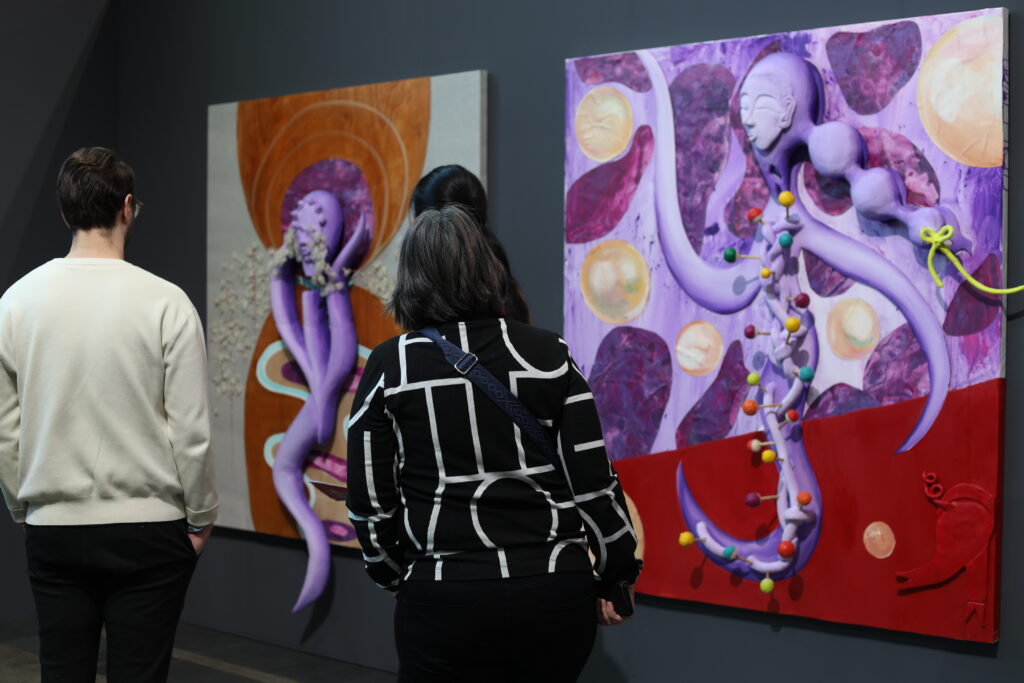
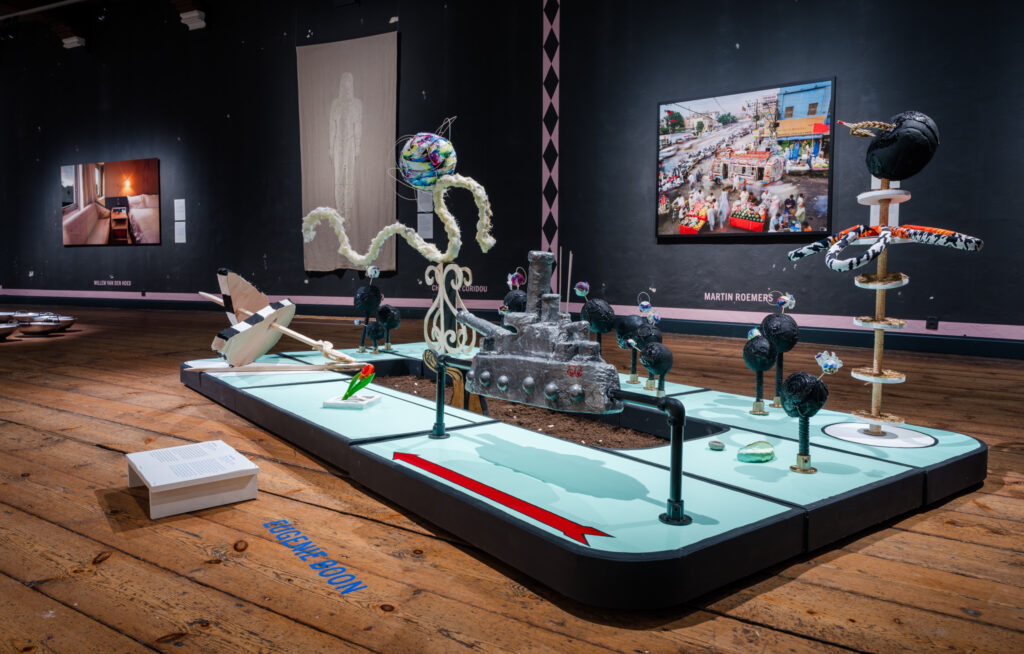
At Prospects at Art Rotterdam 2026, I saw beautiful paintings that were simultaneously sculptures. Prospects is the annual exhibition of the Mondriaan Fund in which the work of emerging artists is presented. The works were by Eugenie Boon, who grew up in Curaçao and is active as an artist in the Netherlands. She is breaking through – ahead of Prospects, an exhibition at Museum De Lakenhal ‘Majalla’s Mantel – Rafelranden van het Leidse Laken’ with Sarah van Lamsweerde in 2024, and a blow-up work on the Lange Voorhout in 2026.
I speak to her in her studio on Ferdinand Bolstraat in The Hague, a spacious room with a high ceiling in a former school that is filled with horizontal works in an advanced state, as well as some works that have been returned and dismantled. In addition, there are some paintings on the wall.
Inspired by Curaçao
In her work, she seeks truth in its broadest form in order to subsequently visualize it, she says. “During my studies, it was a quest for identity and what that relationship—the relationship between the Netherlands and Curaçao—means. I grew up and was raised on the island. I am inspired by Curaçaoan history, and how it has shaped the people. I appreciate, admire, and am fascinated by daily life, the stories, and the creativity.”
For example, the stories of Anansi. “I always loved stories. My father told them before bedtime, and the headmaster of the primary school told them too. Every Monday morning we would gather under ‘the covered hall,’ and then Mr. Welvaart would tell the stories—a man with a passion for children’s imagination. Those were vivid images for me.”
Her father was – in addition to a 9-to-5 job as a printer at a printing company – a photographer and videographer. “It started as a hobby for him. He filmed my birth. Every month on the 29th – my birthday – he filmed my growth. Until I was one year old. He made a compilation when I was five. When I was seven, I saw the compilation for the first time, and also my birth. That raised many questions for me. A world opened up. How a camera can create a world, how you behave in front of the camera and how other people behave, sometimes putting on a performance. I understood the difference between life in front of the camera and real life, comparable to the difference between fiction and reality.”
IBB, Instituto Buena Bista
In secondary school (HAVO/VWO), she took art subjects and chose drawing. After she had taken her final exams, she wondered, ‘What am I going to do?’ “Nothing suited me. My teacher, Miss Apostel, said, ‘Just contact IBB, Instituto Buena Bista, run by David Bade and Tirzo Martha.’ IBB is a platform for contemporary art. I was there for two years. I learned a lot there. On the island, we don’t have the art world in the form of museums and galleries. That is developing a bit now. I stepped into a new world. The IBB had a Residency program, which many international artists attended. That broadened my frame of reference regarding what art can be, and how art can amplify the voice.”
Frans Franciscus from Amsterdam was one of the residents. “I learned the grease technique from him: first a grey layer, then you add color. I was given the Renaissance theme. I created the Allegory of Wisdom & Strength. I also came into contact with artists like Pepón Osorio and his depiction of shared issues. I thought: I have a lot to say. Perhaps it would be wise for me to become an artist. It became a possibility. I started to dream. Before that, I had no reference to the profession.”
HKU Utrecht
David and Tirzo brought her portfolio to the attention of the Academies in the Netherlands. She could have gone to the KABK and the HKU (the Hague Art Academy and the Utrecht Art Academy). David advised her to choose the HKU because it suited her better. She followed the program for four years and experienced it as an enrichment. “Especially understanding the art world itself, the philosophy, cross-media, and art history.”
Eugenie: “The culture of the Academy was quite Western; that realization dawned on me after a while. I was completely open, but I realized that it didn’t grasp my context, my fears, inspiration, or knowledge. I did find it important to create space for my own way of thinking, and not to shrink it. So I tried to give form to my imagination and my symbolic, inner language. I tried to learn all the techniques and I started experimenting. And besides that, I tried to get to know as many fellow artists as possible.”
Ta Nos Hendenan
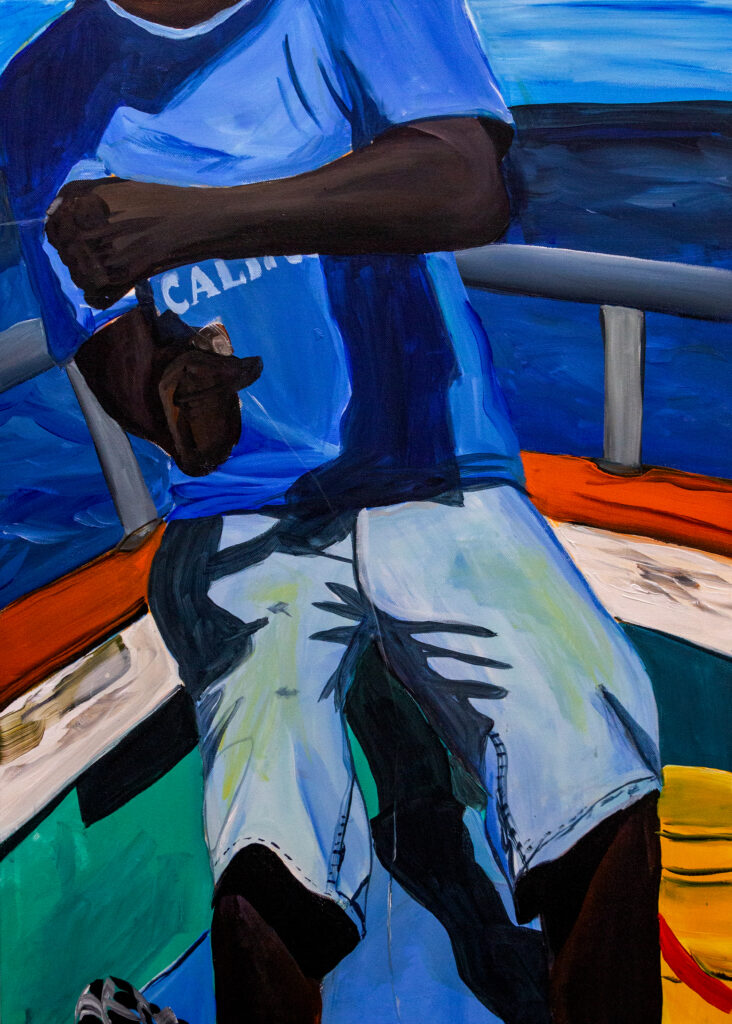
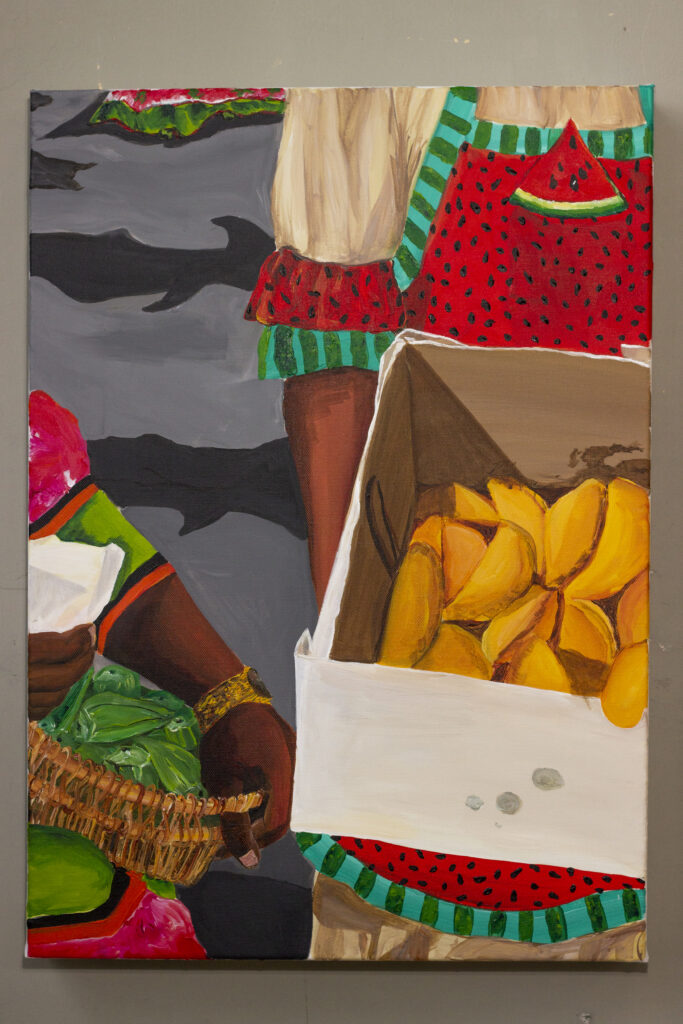
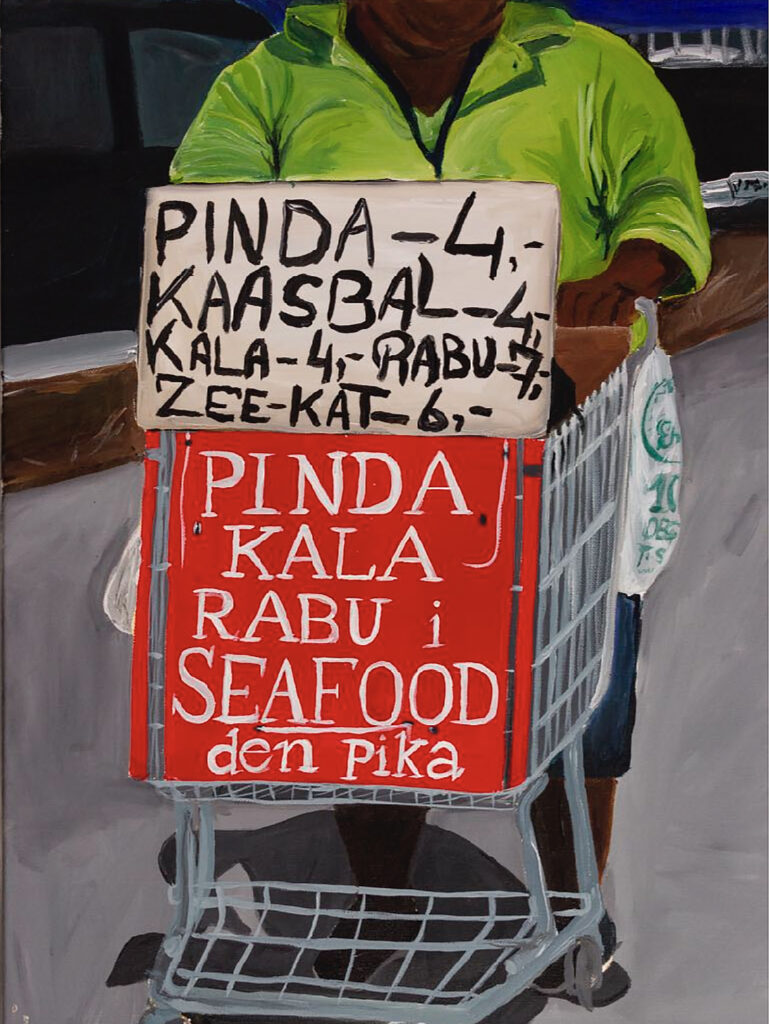
In the second year, in 2018, teacher Lieven Hendriks assigned the task of creating a painting of home. “That touched me; I was far from home. I dove into my image archive, because I was a photographer just like my father. I went to see what photos I had of home. I set to work with those; I didn’t paint literal faces of people. I started cropping and zooming in on a photo to paint things that told a story. That is how the series Ta Nos Hendenan (Our People) came into being.”
She painted people from Curaçao in everyday life. “The kinds of people you thought, ‘this is really something someone from Curaçao would do’.” Two women selling raffle tickets on the street. “Those are people who deserve attention too. 70 percent of elderly people have to sell raffle tickets or choose another occupation to survive because they cannot make ends meet with their pension.” Usually she didn’t paint faces, but sometimes she did, if they had a specific expression.
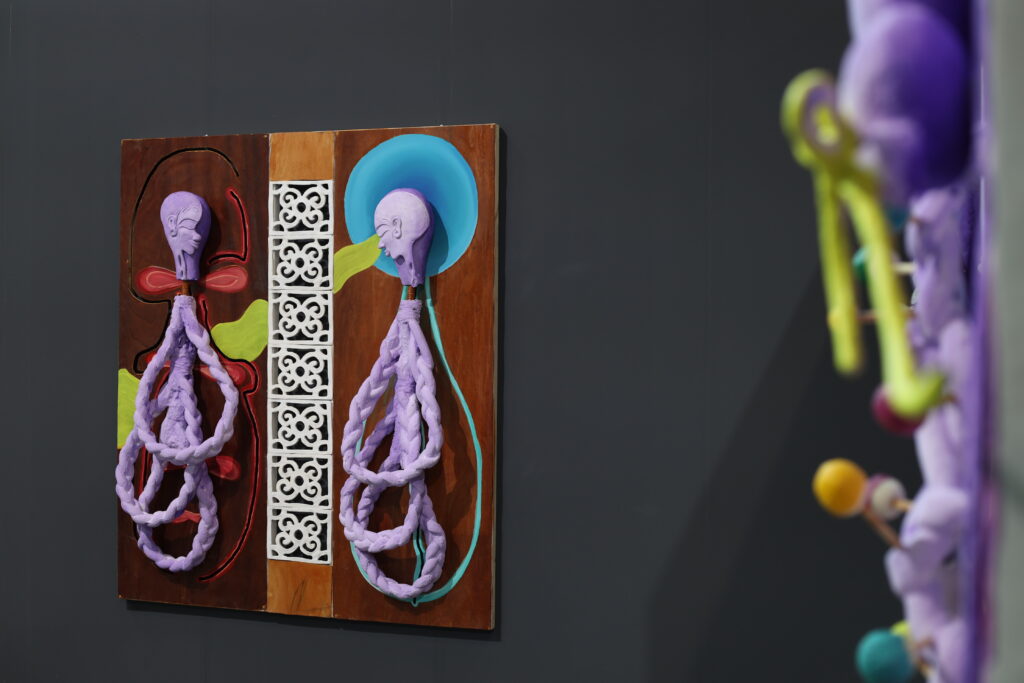
“In that series, my frame of reference emerged: the experiences of people from the diaspora in the Caribbean. When themes were difficult to discuss, I withdrew more into my inner world with more figurative/abstract works, installations, performance, and sculptural paintings. Additionally, I created abstract figures in which I let my inner visual world run wild. A lot of symbolism with many forms, especially of braids, legs, and the structure of DNA.”
Painting and sculpture at the same time
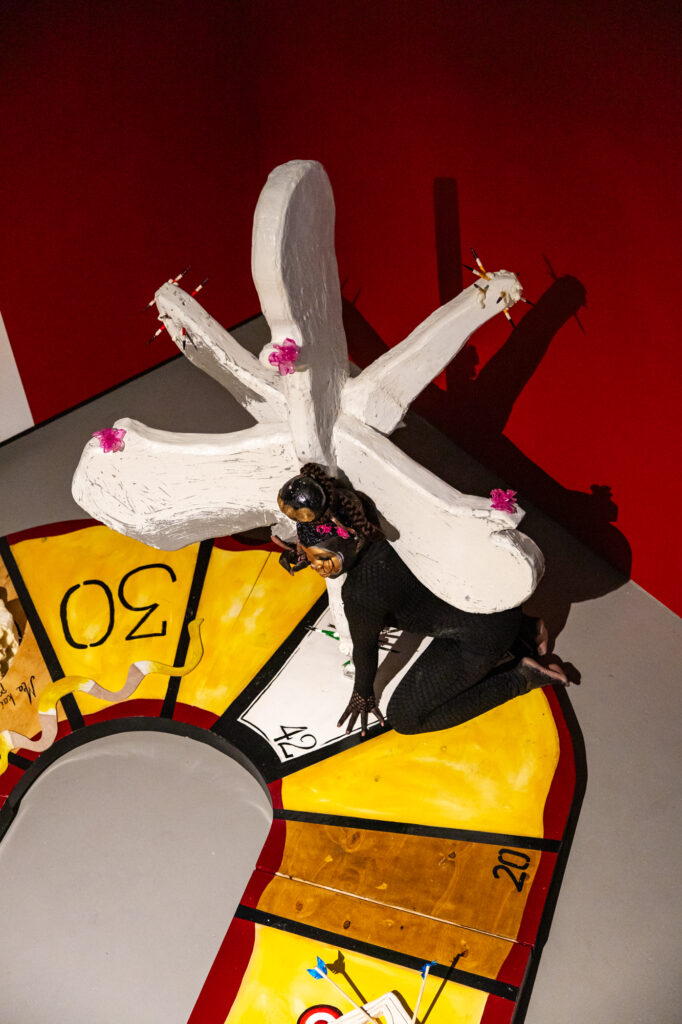
It didn’t stop at paintings; they moved in the 3D direction. Some were painting and sculpture simultaneously. “That started in the third year. I grew up with Carnival, Carnival parades with sculptural expression, Kanal Elouisa (TV program), with comedy and performative shows. To incorporate all this nuance into the series Ta Nos Hendenan, 2D felt too flat. Why not combine them? I graduated with works like that.”
In 2020, she won the HKU Award for Artistic Achievement with a sum of 5,000 euros. The certificate is leaning against the window. “It helped me invest in materials, a saw machine among other things. I wanted to graduate with these works, and I could. I was happy. When I graduated in 2020, everything was closed because of Corona. A strange moment.”
Awareness of the History of Slavery
Despite that difficult time, she was able to secure many commissions, particularly around the theme of ‘Awareness of the History of Slavery’. The series Ta Nos Hendenan received a great deal of attention. “At one point, I thought that this was limiting my creativity. That I also needed space to deepen my own unique world, to explore new themes. So that it is not just about my background, but has general validity. I then took back control. Human thoughts, humans in relation to other people and to nature, remain interesting to me. The in-between world between fiction and non-fiction. When I am invited to respond to something, I enjoy diving straight into history and building a story in which I leave room for suggestions and other perspectives.”
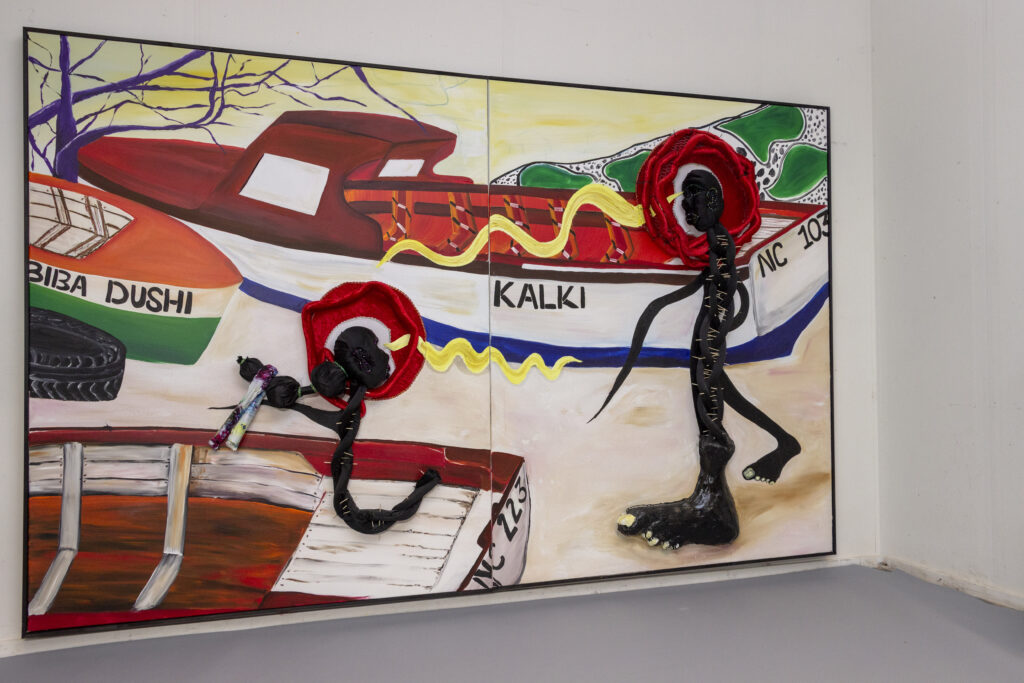
She loves playing with materials. She uses molds and foam board, hardens insulation pipes with a layer of plaster and coats them with a two-component paint, and uses clay, silicone, PU resin, epoxy, and textiles. She gives me a small pink flower created in this way. She also uses decorative blocks. “All Caribbean houses have decorative blocks. That way, air can flow through the house. A bit like Bauhaus. I create my own design using those decorative blocks as part of the continuity of and my appreciation for the design and architecture I grew up with. I try to use more elements of Curaçaoan architecture.”
Does she have a key work?
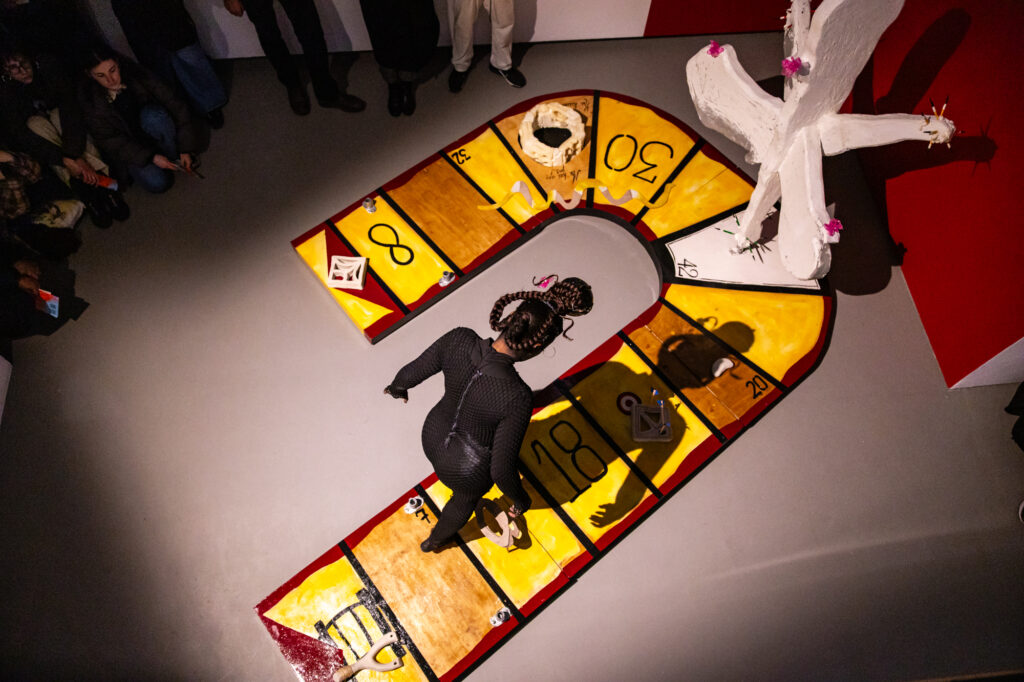
Yes, the series Ta Nos Hendenan is a key work. “All the stories, my origins of perspectives and references, can be seen in those paintings. These paintings are my image bank, my repository.” She also wants to mention the performances she does with the character Pegasaya. Pegasaya is Anansi’s youngest son. “That youngest son is an observer. Anansi is a trickster; during slavery, he became a hero who knew how to survive in all situations. They were instructions for staying afloat when there is no infrastructure. Those methods of survival no longer fit in this day and age. It is time to build infrastructures that work for us and suit us.”

What is her experience with the art world?
“It’s a privilege. It is nice to be able to think and imagine my own inner worlds as work. I have all the space to keep the child within me alive. When I am dead and possibly come back to life again, I want to become an artist again.
It remains a world where you have to prove yourself; you have to keep growing. It demands honesty and integrity. I feel a responsibility stemming from my privilege: I have to do something with it. That is not easy, but it does bring pleasure.”
Finally, what is her philosophy?
“I see art as a developmental tool to strengthen the imagination, thereby giving space to different voices and perspectives.”
https://www.instagram.com/eugenieboon.atelier
https://www.mondriaanfonds.nl/activiteiten/prospects


Leave a Reply