
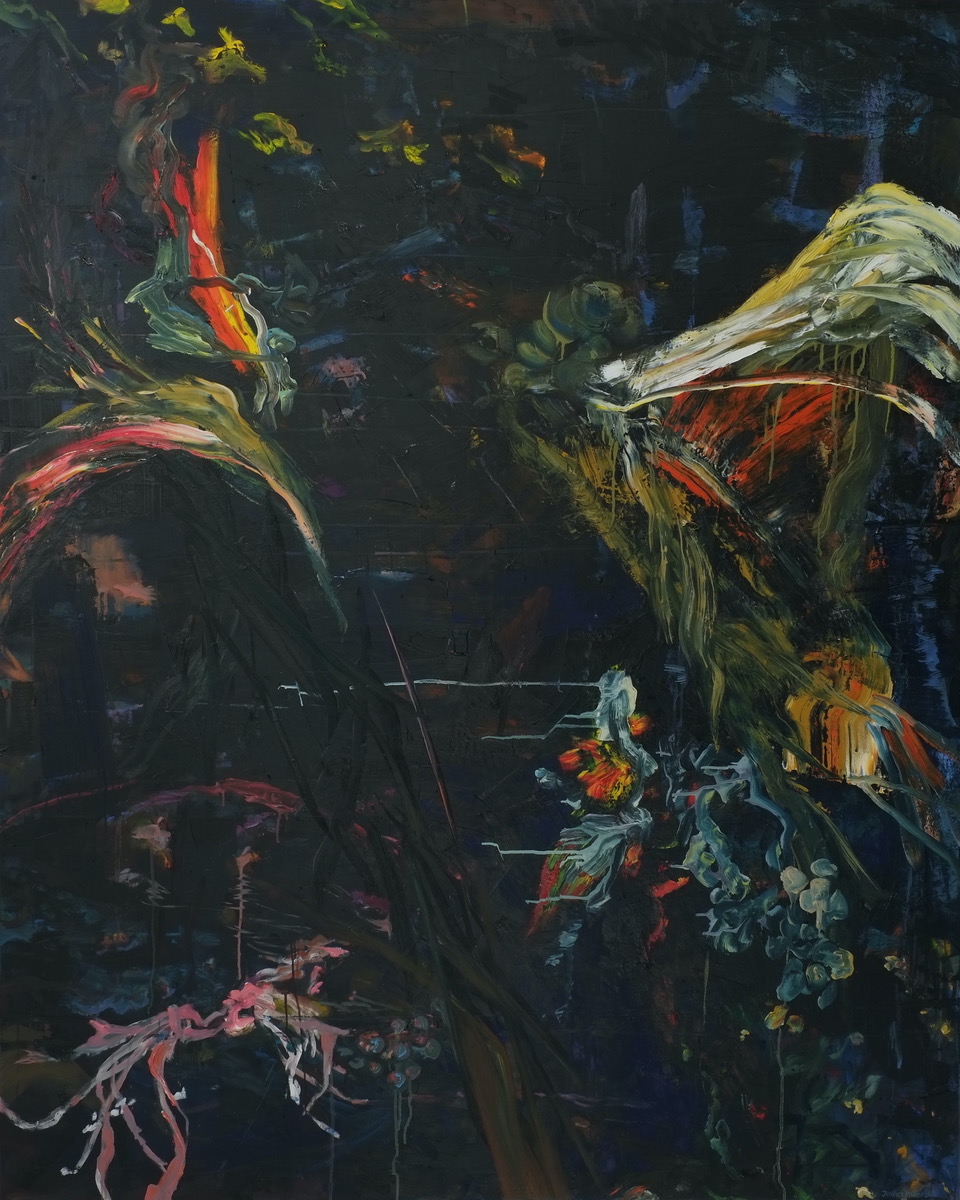
Jessica Muller’s work is colorful, layered, has depth, and is about nature. At least, that is what you would say at first glance. It could also be about other things, about the world, or what can rage inside a human mind. In the Hardenberg Hall of Pulchri, I saw her work, along with that of the other two nominees for the Van Ommeren – De Voogt Prize 2025.
Reason enough to go talk to Jessica about her work. I took the train and the bus and arrived reasonably quickly in the wooded area of Barchem in the Achterhoek. There is a note on the front door telling me to walk through to her studio, to the left of the house. And there, indeed, is Jessica. While she makes coffee, I look at a number of paintings I saw earlier at Pulchri. Her prize-winning painting, slightly smaller than the others, is also standing on an easel.
Tension with toxic hues
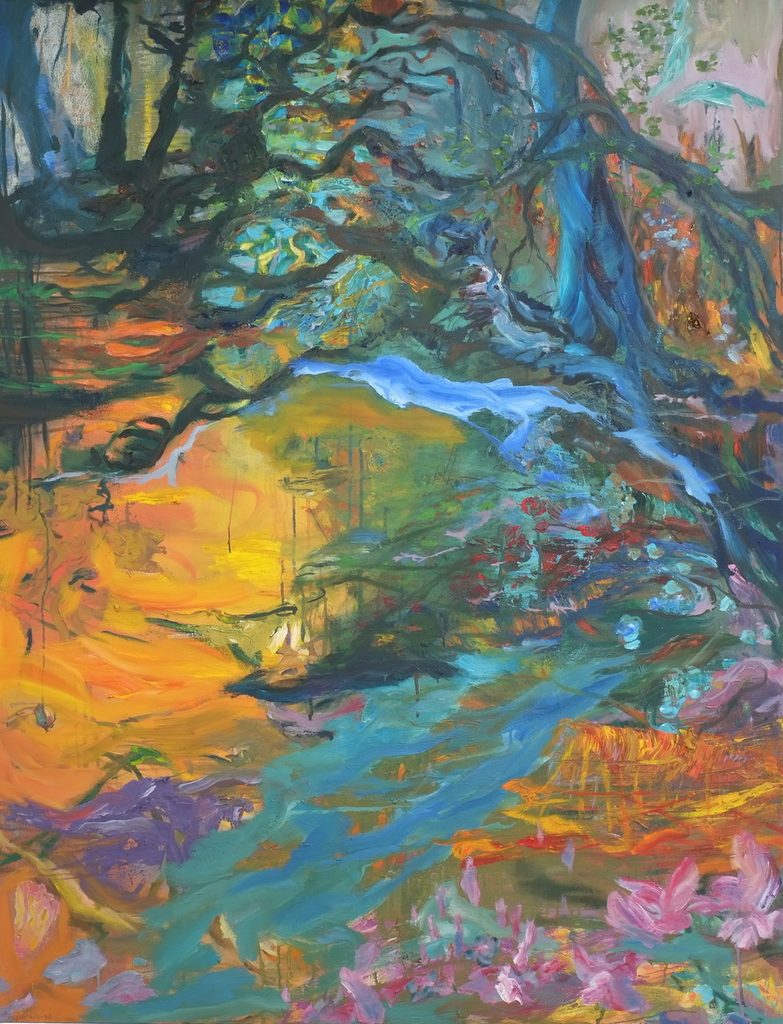
In the work Jtn25 – which the jury had selected – we see a tree swaying violently on a rocky outcrop, while an enormous stream of water thunders down, the force of which pales in comparison to a massive yellow outpouring from something black. Alongside this is a purple, cloud-like upper body with blue lines running through it, beneath which lies a fiercely swaying green bush touching the yellow outpouring.
The jury said of it: “Idyllic from a distance, yet chaotic and almost hellish up close. With toxic hues that create a tension between attraction and repulsion, the work remains balanced despite its overwhelming chaos. Her search for the autonomous image, working from emptiness and grappling with fundamental questions about painting, was considered authentic and compelling.”
Chaos and Balance
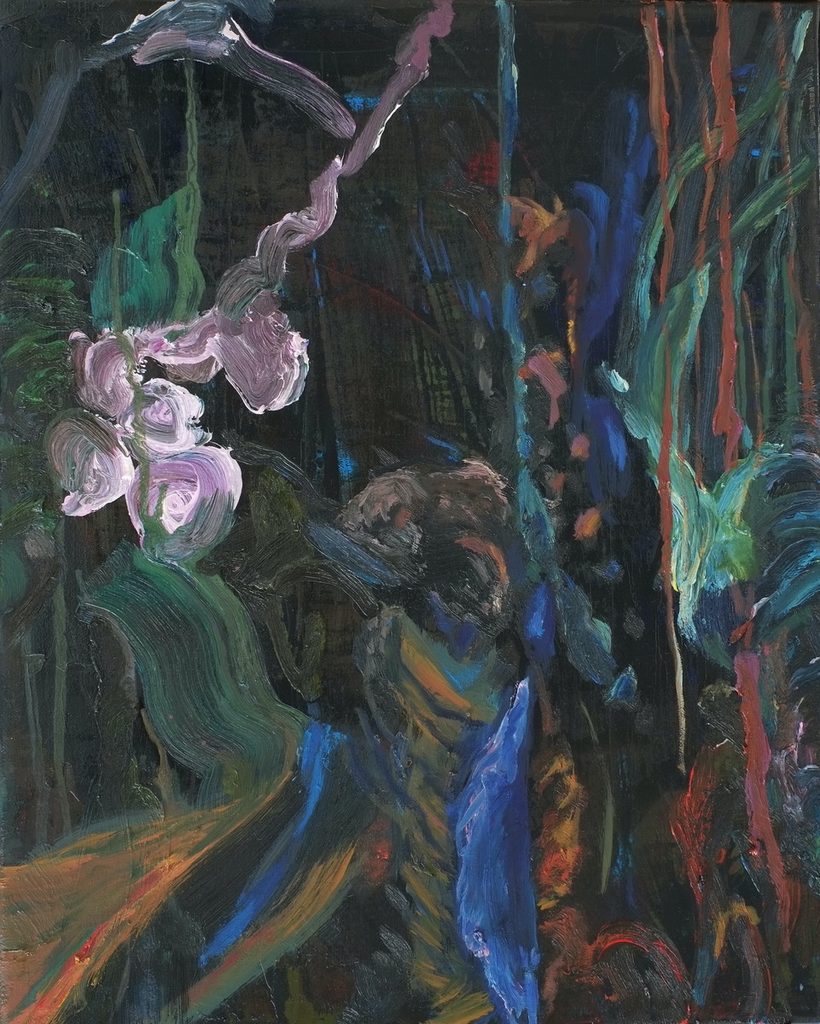
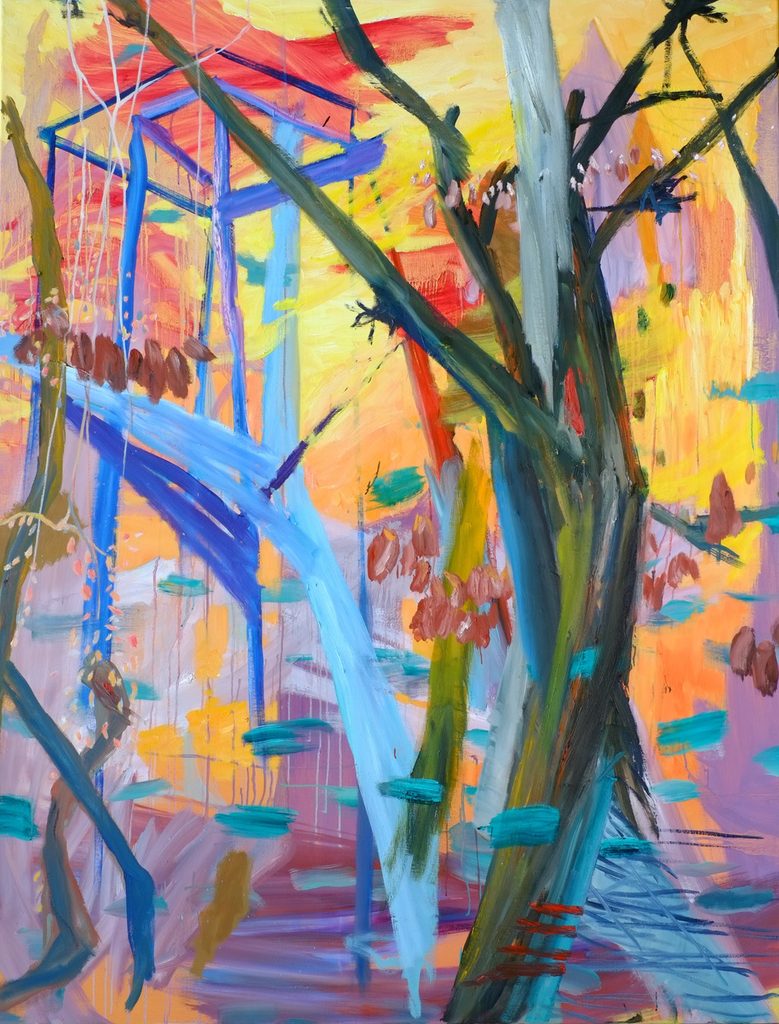
In her response to the jury, she indicated that during the painting process she seeks out unknown images, without a preconceived plan or meaning. “There is only the painter’s presence in the now, with the material. During the process, conscious and unconscious perceptions become physical movements with that material. The direction of the image changes regularly. Illusions appear that are dismantled with new colors, strokes, and lines, creating chaos anew. Layers of form and anti-form exchange with one another. The end result is a found point of stillness, a balance. A space has been created in which the viewer can wander around and—through the colors and forms—experience images built from their own associations. The image has a unique interpretation for every viewer.”
It is a kind of meditation, she says. “There is no plan. When I start, there is still paint on my palette that I apply randomly to the canvas. I add new color to it. Unconsciously, my brain starts associating, yet I always return to the composition and not to a potential story. To do that, I turn a canvas, turn it upside down so that the associations disappear, and apply new layers. That can happen quickly. I work on several canvases at the same time. I create a dreamlike world. You can also intervene in your dreams. I do that a lot when I am painting. I kill a lot of Darlings. I love paint.”
Past times
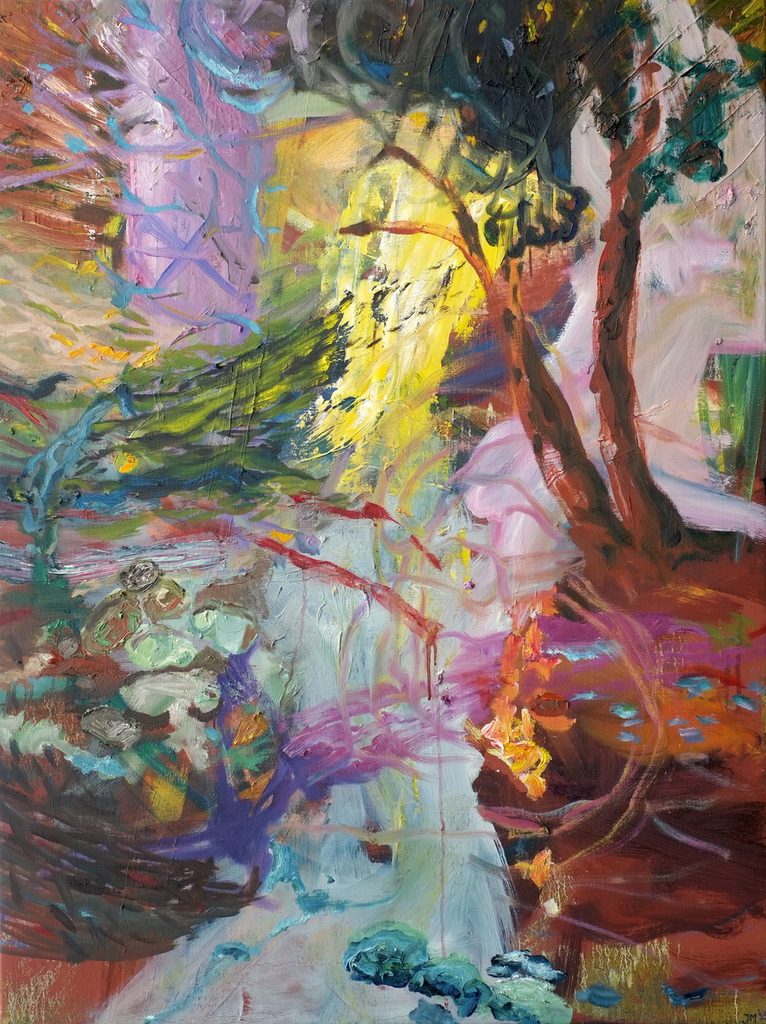
Yet there is a story, but it is hidden. She does not want to reveal too much about it. But after a while, she does tell a few things.
“I have always been occupied with myself in the world,” she says, “but at the Academy – the KABK, the Royal Academy, – that wasn’t such a focus, engagement and profundity.” In the background of the work she created, there was always the theme of how people relate to each other and to history, including things related to her family. “But I didn’t want to share those; things flowed from that that could cause a stir.”
Jessica was born in Bergen, Germany, close to the former Bergen-Belsen concentration camp. “My father was a professional soldier and was stationed there for NATO. A week before my birth, he took my mother to walk around the grounds of the former concentration camp.” As the family of a professional soldier, they moved many times and sometimes lived somewhere for only a few months. At some point, her father left the army. “I grew up in that atmosphere. I constantly observe how people interact with each other. That is reflected in my work.” Incidentally, she didn’t really hear what had happened in World War II until she was 16, when she was in secondary school taking history. “It wasn’t discussed at home, even though profound events had occurred in the families on both my father’s and mother’s side during that war.”
She has always tried to understand events through reading. When she was little, she read the children’s Bible, travel stories, and composer biographies because she found stories about people’s lives interesting.
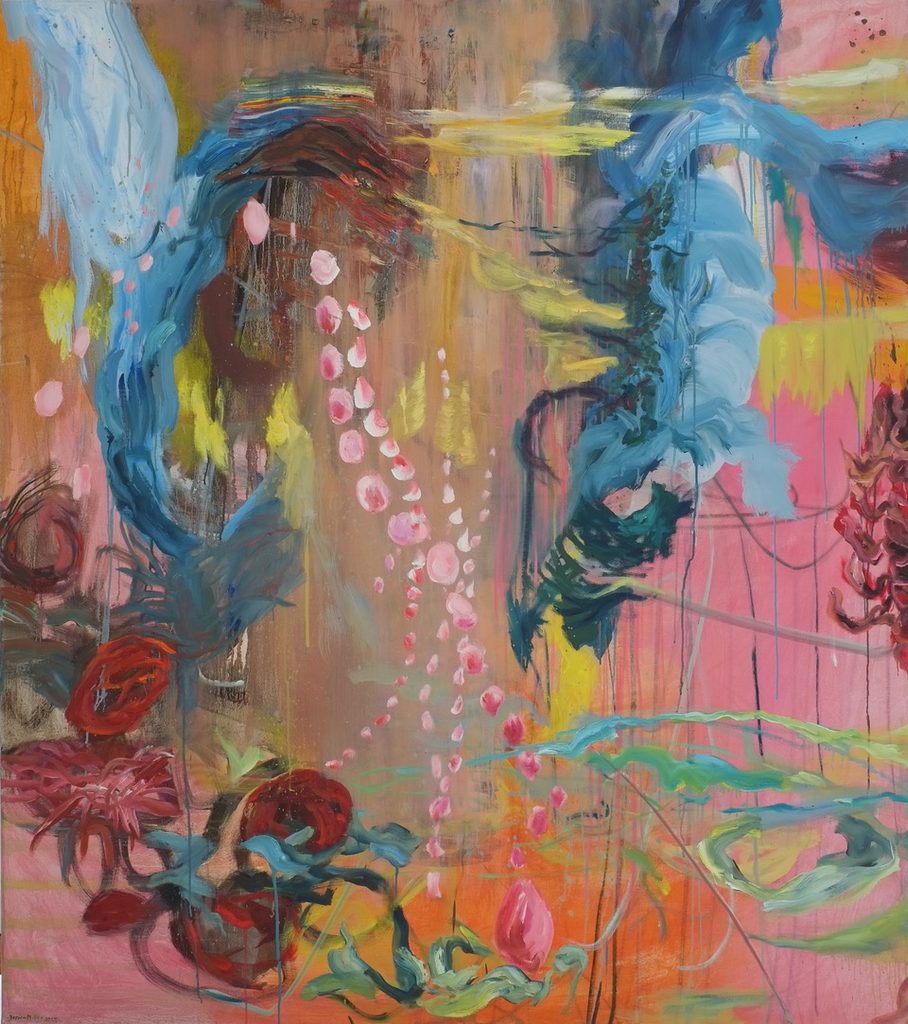
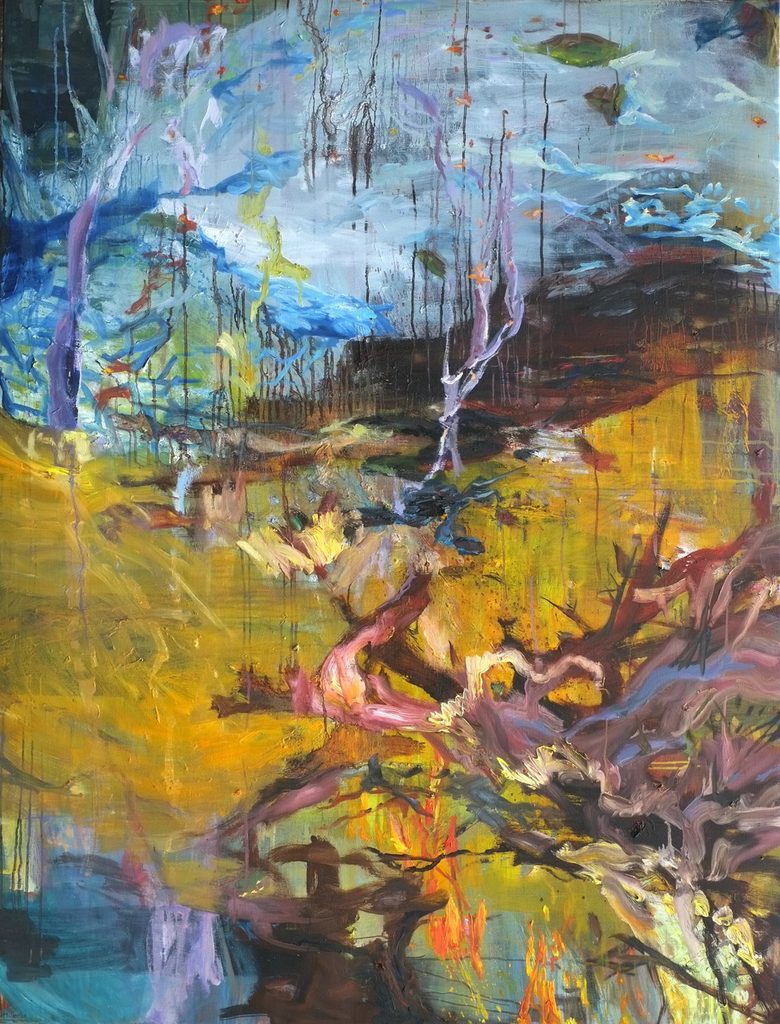
For a period, she created abstract cubes and boxes about gas chambers, but she never revealed that they were about that. Subsequently, paintings with geometric shapes, often diamonds, and frequently featuring the color yellow. In her current work, more detail and organic forms are visible.
Hinduism and Buddhism
Four years after graduating from the academy, she had had enough of Western culture and started reading Störig’s introduction to philosophy, immediately becoming captivated by Hinduism and Buddhism. How is ‘community’ dealt with there? It occupied her for eight years, during which she read everything from the Mahabharata to many contemporary Indian writers.
From 1992 onwards, she traveled to India four times. First for a month, then for two months, and finally in 1997, with a grant from Stroom (Hague Centre for Visual Arts) in her pocket, she spent six months at two different studios. She exhibited in Madras and Trivandrum with work that expressed her interpretation of Hindu philosophy. “Women do not have much say in India. Western women even have the same status as pariahs. How did I relate to that world as a Western woman?”
She also traveled around the country. “In Rajasthan, people used to live in forts in the desert that fought against other forts. If the opposing side was defeated, most of the other warriors were killed, and the women ended up in the winner’s harem. But the women did not want that and committed Sati; they had themselves burned with their slain husbands.” Jessica created installations and paintings of hands that flame about this.
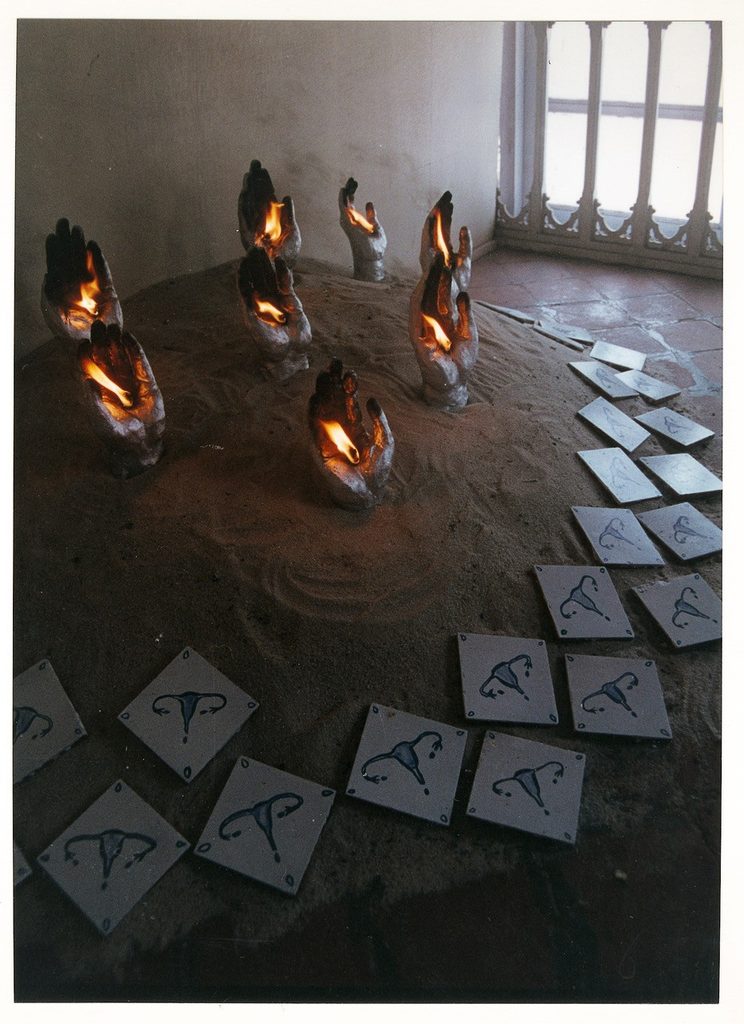
In those forts, she often saw Delft Blue tiles, only they weren’t Delft, but Chinese, because those blue tiles originally come from China. “This inspired me to create tiles with a flower in the installation with the burning hands, but on closer inspection by the viewer, that turned out to have become a womb.”
In her studio in the Cholamandal Artists’ Village, near Madras (Chennai), a few Indian female artists also worked, including Sajitha Shankhar, who has become very well known in India. “I talked to them about their art, and how one could lead an artist’s life as a woman. I noticed that my perspective was impregnated by Western influence. I couldn’t quite place their work. The Italian artist Francesco Clemente, a ‘new wild’ who created neo-expressionist work, was also working nearby. The Indian artists were certainly impressed by this. The Indian artists in Cholamandal had set themselves the goal of breaking away from colonial art. They were searching for what was truly Indian. That was not so simple.”
In 1997, she exhibited her work at Sri Chitra Art Gallery in Trivandrum: installations of aluminium and paintings of the ‘flaming hands’. Besides India, she also showed this work in The Hague at Quartair and during studio tours. But people didn’t understand it. After that, she decided to focus solely on paint and colour for the time being.
The content is in my head and my heart
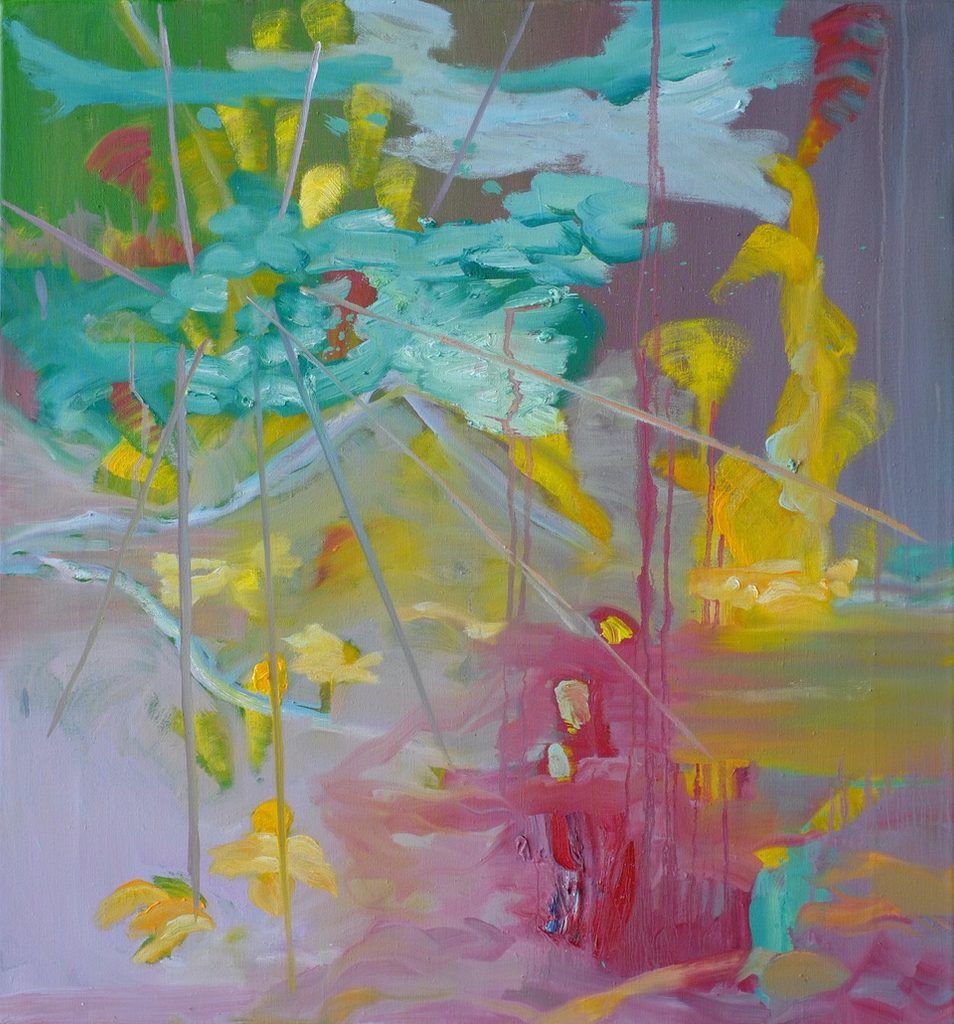
She resumed working on abstract art, based on the premise that ‘the content is in my head and my heart and recurs in the associations I stack’. Her thought world was primarily based on Jungian psychology and, later, on ideas from anthroposophy.
Derrida
In 2014, she graduated cum laude with a First Degree in Visual Arts & Design Education from ArtEZ to teach part-time. She derives great pleasure from guiding secondary school students in expressing themselves and, through that, relating to the world around them.
Western culture and philosophy had thereby come closer again.
In Derida’s deconstructivism, she saw a similarity to her own way of working, her painting.
Derrida calls the dissection and tracing of the unwritten part of that text in the margin ‘deconstruction’.
“Every text you read actually relies on all the texts you have already read before it. On all the knowledge you have already gathered as a result. Without all those previously read texts, you would not be able to understand the text you read last at all. In essence, therefore, that final text does not refer to reality, but to all the preceding texts.”
In the field of a book page, all this knowledge is ‘in the margin’ of that final text. “That means that the white space next to the text and between the lines carries an immense amount of meaning.”
This seeking out of the unsaid, the unthought, the excluded—which is therefore not there but nonetheless exists—corresponds to what Jessica does during her painting process, she says.
What is her experience of the art world?
“The road winds and does not always lead where you would like. Ideals change form. Time and money are factors you cannot avoid. And you need others.” She has always strived for self-reliance and independence. When she was a student, she lived in a house with academy students from other disciplines. They founded a cooperative artists’ association: ‘Limiet Oneindig’, with which they arranged anti-squat studios and undertook many collaborative projects, for example for theater. After five years, they went their separate ways, and she moved to a studio from Stroom. She started filming with Frans Zwartjes in 1997, made her own videos and documentaries, and worked as a part-time editor. She became a member of the Haagse Kunstkring and Pulchri. In 2006—on the occasion of the 160th anniversary—she made a film about the raison d’être of an artists’ association like Pulchri, featuring interviews across the entire arts scene in The Hague. That film can still be seen in parts on YouTube. In 2009, she wanted to leave the city (with her husband and child) and move to nature, so she relocated to Zutphen. Once again, she joined an artists’ association, the GBK Arnhem, and organized projects with visual artists from Gelderland, such as ‘Spotlight’. The GBK was eventually disbanded. Pulchri remains important to her because she can show her work there and speak with colleagues.

There were also various galleries she collaborated with over time. Her work has been sold by the online gallery Saatchi since 2015. Then it flies to America, London, or Sydney.

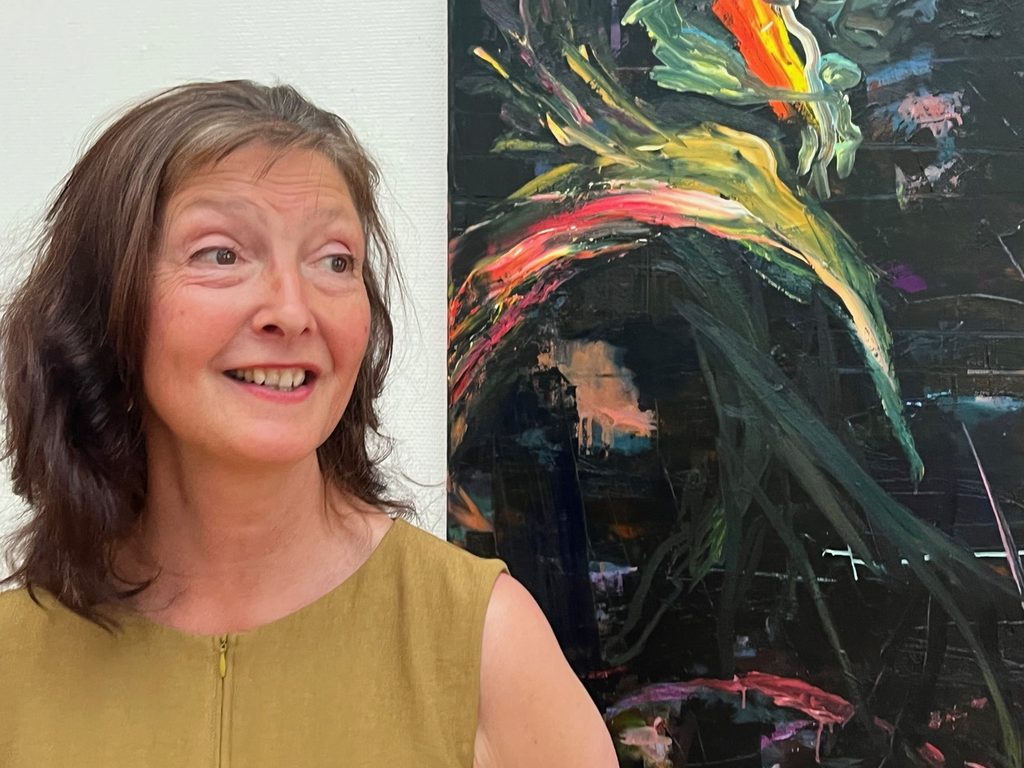
Images: 1) afw26, 2) tsh26, 3) trs26, 4) jtn25, 5) mrt25, 6) gch25, 7) Sati installation, 1997, 8) smg22, 9) lst22, 10) plg23, 11) vld23, 12) portrait photo Jessica Muller
https://jessicamuller.nl/
https://www.instagram.com/jessicamullerartist/
https://www.pulchri.nl/nl/tentoonstellingen/jessica-muller-tussen-de-regels/
https://www.saatchiart.com/en-nl/account/artworks/616263
See also: https://www.youtube.com/watch?v=K9jqhizNaxA