
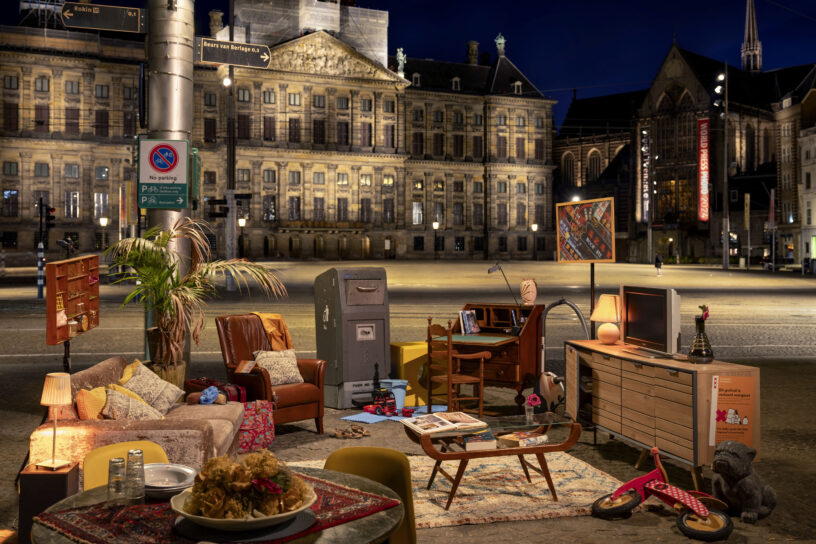


In The Hague, there are ORACs (underground residual waste containers), and in Amsterdam, OACs (Underground Waste Containers) for depositing household waste. Some have sensors that indicate when they need to be emptied. This way, garbage trucks have to take away less. This new technology is leading to an unexpectedly new streetscape in both cities: people are also placing their bulky waste next to these containers, so they are completely surrounded by old chairs, cabinets, curtains, and mattresses.
However, that does not apply to all neighborhoods; in many neighborhoods, people—as far as their bulky waste is concerned—strictly adhere to the municipality’s bulky waste collection days.

An underground container on Javastraat
Photographer Boris Suyderhoud lives on Amsterdam’s Javastraat, opposite one of those underground containers. He saw a constant stream of items appearing at that container. He wanted to do something with it, he tells me at the exhibition INT / EXT Amsterdam at the WMGallery.
“I saw a constant stream of items, including a lot of furniture. I thought I could transform that into a domestic scene without much effort by placing them on a rug, for example. Add a small lamp that could also provide light.” He had to find a limit; he arrived at a collection of items one evening in a neighborhood. It became his muse. In 2019, he created a first series of five images in five city districts; the first image was in the Indisch neighbourhood (Indische buurt).

The items come to life
He got to work on a bulky waste collection day. He drove around a specific neighborhood in a van with someone from the area. “You also see other vans looking for items, some looking for steel, others for electronics.” He hauled the items together and then created a beautiful combination of them. “I lit it up completely, including the surroundings. The lights contain a small flash, and that brought it to life. It felt as if it had just been abandoned. Typically Dutch coziness. Each photo is a single shot; I combine two techniques to achieve the final result: flash light for the foreground and a long shutter speed to illuminate the background.”
In 2022, a second series of five scenes followed, and in 2025 he completed the domestic scene project with the final seven images.
In the evenings, there were many responses from local residents. ‘Is it for sale or for rent?’ ‘Can we take it with us when you’re finished with it?’ That was possible. When it was finished, they could load the items up.

The rattan chair
An underground waste container is also on display at the exhibition. As are items that were placed alongside scenes, such as a beautiful wooden goose. “Various objects were given a new life through the installation. For example, the rattan chair that stood alongside it in the Vogelbuurt. It was actually discarded. But for someone else, it was new. It offered a new interpretation of the relationship between people and objects.”
Almost all neighborhoods of Amsterdam have had their turn: 17 in total. The exhibition in the gallery is organized by district: north, east, south, and west, and the photobook INT / EXT Amsterdam follows this division as well. In the photobook, Renée Kapitein wrote the story accompanying the images, and illustrator Gijs Kast created a map of Amsterdam showing where the images were taken. The book has been well received. The project and the book received attention in various media.
Can he point out a key work?
He points to the photo in front of us of the first installation in 2019 in the Indische buurt, an interior with two chairs and Venetian blinds. “That was a eureka moment.”

How long has he been an artist / photographer?
“I see myself more as a photographer than as an artist, an applied documentary photographer. I always have a story, which revolves around putting things in a new light, causing you to look at them in a different way.”
Boris Suyderhoud attended the Fotovakschool, a solid technical education in Amsterdam, and graduated in 2013.
He helped with the setup of the exhibition. “How you present something is also important. There is more to it than just printing the photos. You can also ‘tickle’ people in a certain way.”
Finally, what is his artistic philosophy?
“How do people view their possessions? Some find ‘having’ very important, while others are content with something simple. You decide for yourself what value you assign to something.”

Images: 1) De Dam, 2024, 2) Vogelbuurt, 2025, 3) De oude Pijp, 4) Vogelbuurt Chair, 5) De Dam Vase, 6) Boris Suyderhoud at the exhibition.
https://borissuyderhoud.com/
https://www.instagram.com/suyderhoud_/
https://gallerywm.com/WP/boris-suyderhoud-int-ext-amsterdam-exhibition-book-presentation-10-04-16-05-2026/
https://inzaken.eu/index.php/2026/04/26/boris-suyderhoud-werpt-zijn-licht-op-de-constante-stroom-van-spullen/


Leave a Reply