
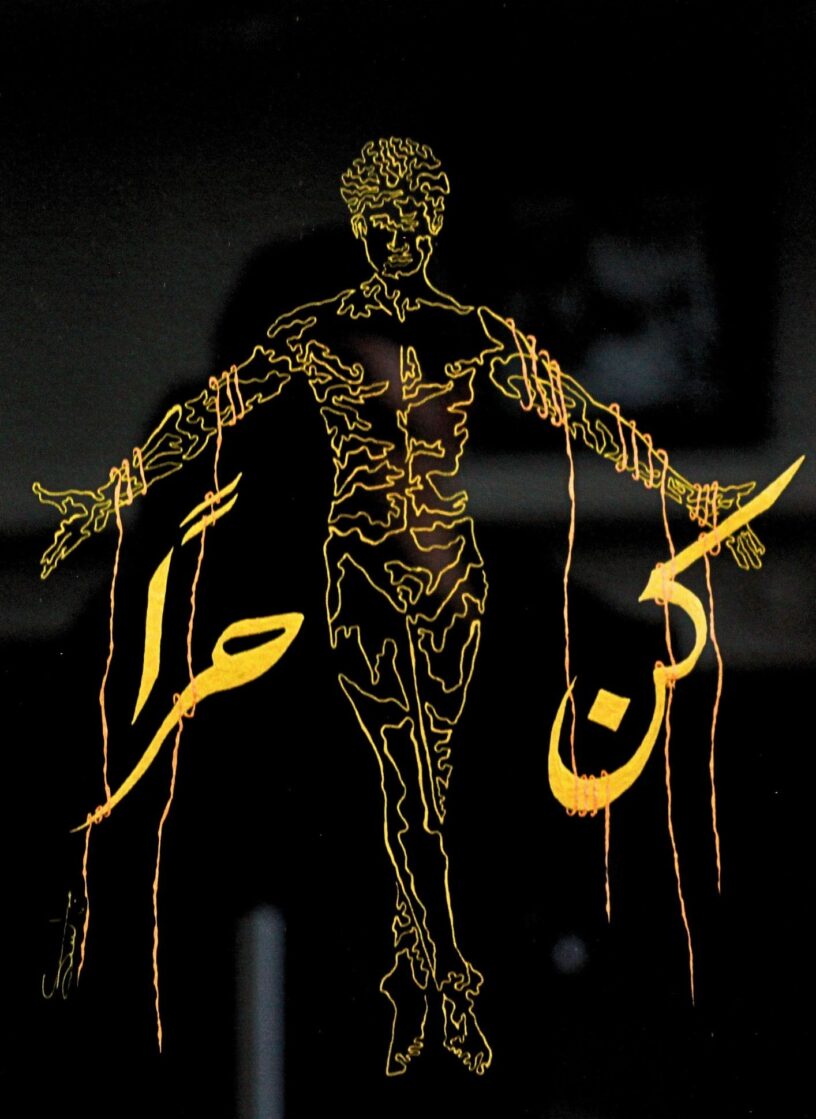


At the very first Van der Linde EXPO in the Vrij Paleis, I saw a golden silhouette on the wall. It was something special. The maker was standing next to it: Saeed Zamzam, originally from Syria. We agreed to discuss it further in his studio.
A few days later, I am at the studio in Slotervaart. The Sloterplas lies just a little further away. The former school building has recently been converted into a studio building. There are people who have just moved in. With some difficulty, I find Saeed’s studio, which is already fully furnished. Many artworks on the wall to the left and a desk to the right. Saeed:”The building will be officially opened in early June.
Identity and emotion
He says that all his artwork is about identity and emotion. “I look at body language. The body says more than someone’s words. Everyone understands the language of the body.
All the paintings depict a human being. Sometimes there are two, then it is about the interaction. First he writes a story, he says. Next, he asks a dancer to demonstrate the form he wishes. He then draws a line that eventually ends up back at the same point. “In my view, that is the line of every human being, ‘from breath to death’. At the same time it is a non-stop infinity.”
The image he has drawn evokes a feeling; it tells a story that conveys the deep idea behind the scene. With these scenes, he opens himself up to the viewer. The works are about his life, his travels, and his development. There are scenes from Syria, Lebanon, Hungary, and the Netherlands. He feels support for his art: ‘People believe in my art. I have been here for four and a half years now. After nine months, I had my first exhibition in the Netherlands.
Gold
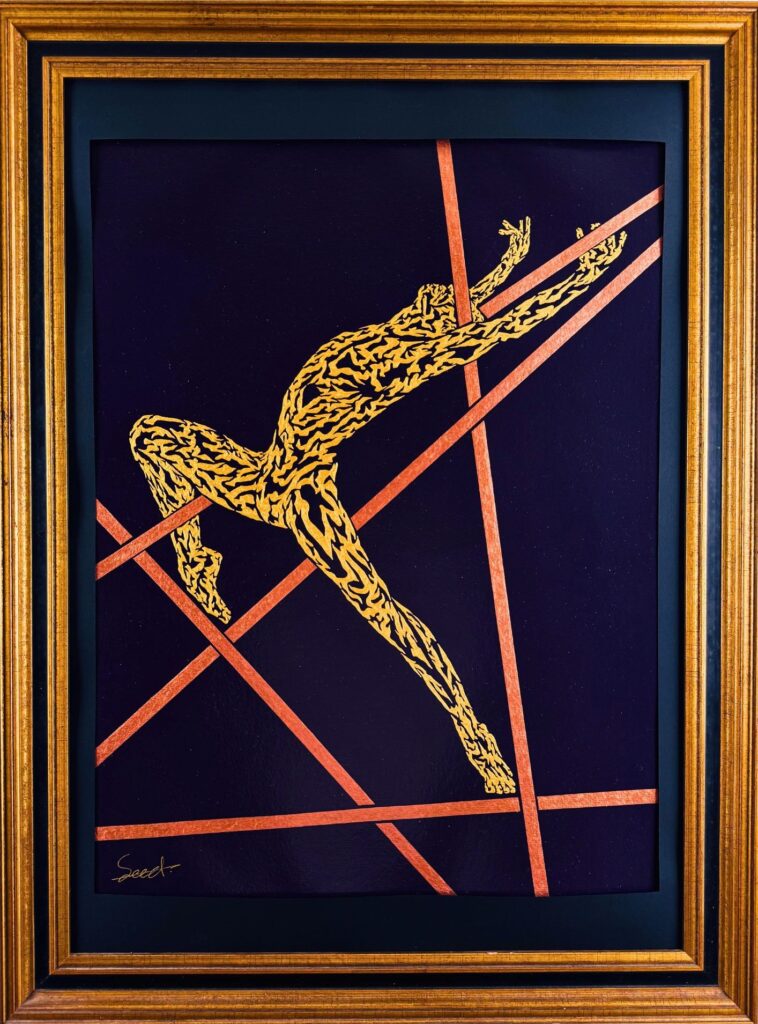
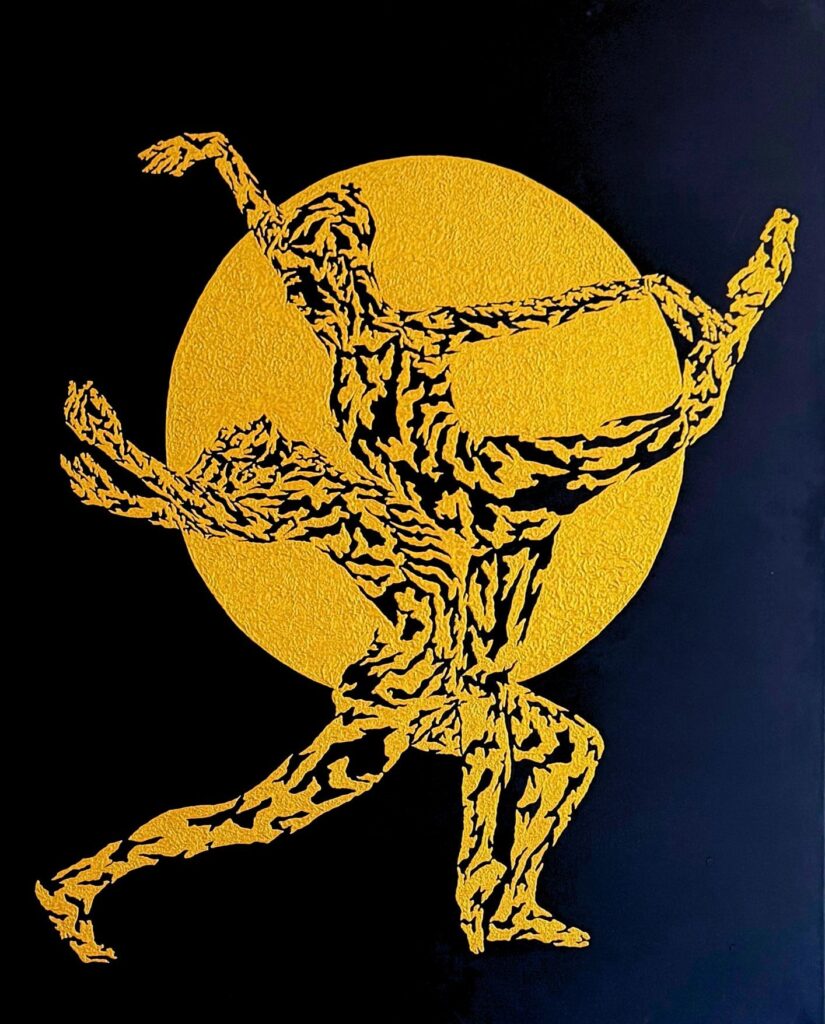
He always puts gold in his paintings.” The whole world is fighting for gold, oil, and diamonds. But people are the real gold. Wars should not be about raw materials. If humanity is at the center, the realization will sink in that wars are senseless. The importance of humanity is so significant that I express it in gold. Most certainly, it is a more expensive material than colored paint, but that way viewers pick up the message better. Art, however, is more than a message, or something beautiful on the wall; it is a feeling.”
Many people understand his paintings, he says. Sometimes he draws two figures, a girl and a man, both from the same line. “We are all connected to each other; sometimes we forget that.” As an art therapist, he gives workshops on this to children and adults. “Then I instruct them to draw a random line that must subsequently end up at the starting point. Then I ask the students to fill in the areas with a specific color. They then have to explain why they chose a particular color.”
Yellow is the color of a sunny morning, an honest moment; with green, it is about nature, of a tree or a plant, it radiates calmness. It is not without reason that you see a lot of green and blue in a hospital. They are good colors for the eyes. If people choose the color red and say that it is the color of blood, he does have a question for that person. Perhaps something is wrong with that person. “I do not connect with blood. I saw a lot of blood in my country.”
Interior Design and Scenography
He studied Interior Design at the University of Aleppo and subsequently taught at the University of Damascus as a professor’s assistant. After that, he was affiliated with Yarmuk Private University for three years. There, he studied Scenography to shape theatrical reality for plays and films as a theatre maker. Upon completion, he worked as a screenwriter in Syria and Lebanon. He served as art director for more than 20 plays and 25 short films.
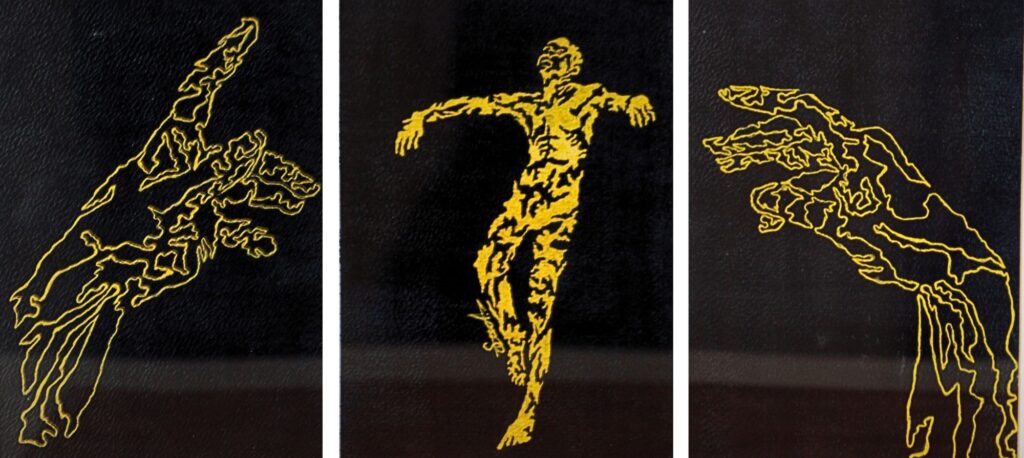
The Blind and the Mute
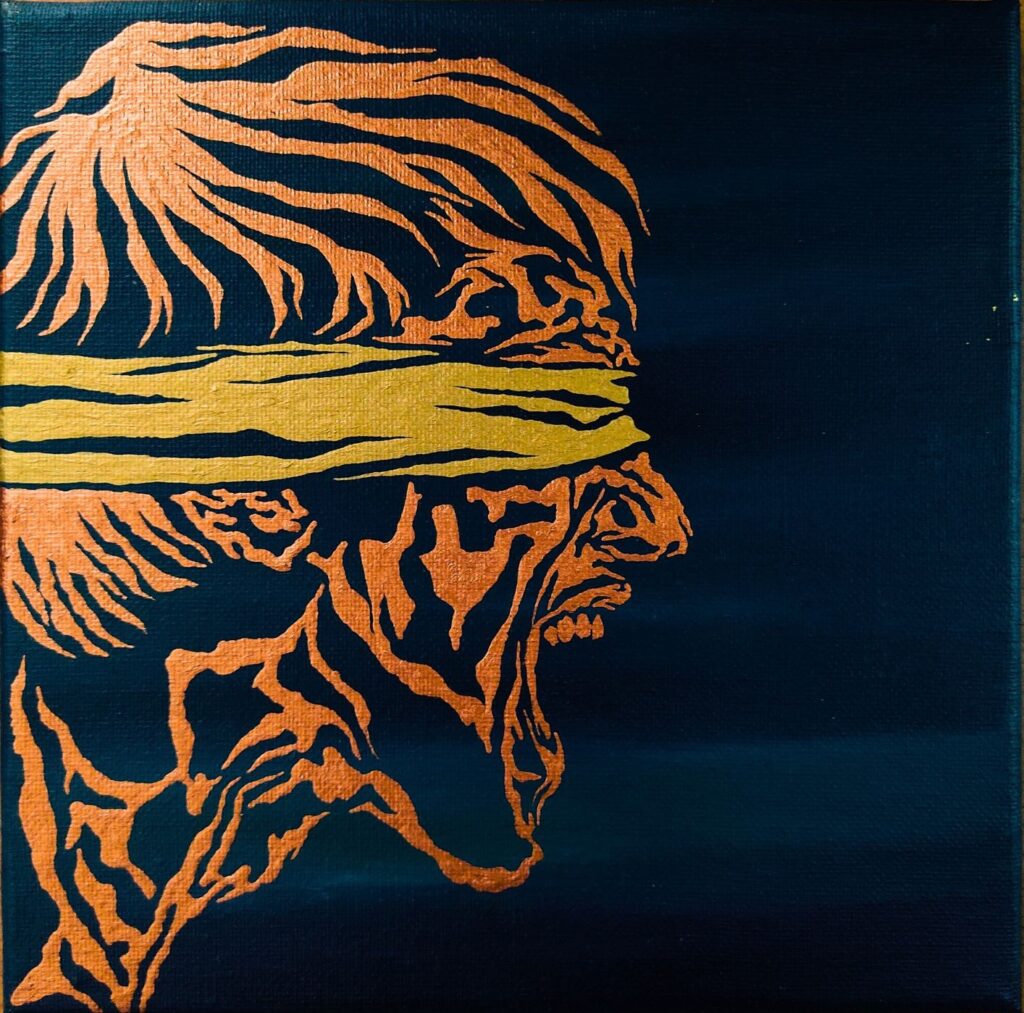
I turn around to take a closer look at a number of his paintings. In one work, we see the faces of two figures wearing bandages; for one, it is a blindfold, for the other, a cloth over his mouth. “I am trying to make the two people speak to each other. It is called ‘The Blind and the Mute’. Person 1 sees nothing, shouts and screams; person 2 sees everything, but does not want to talk.
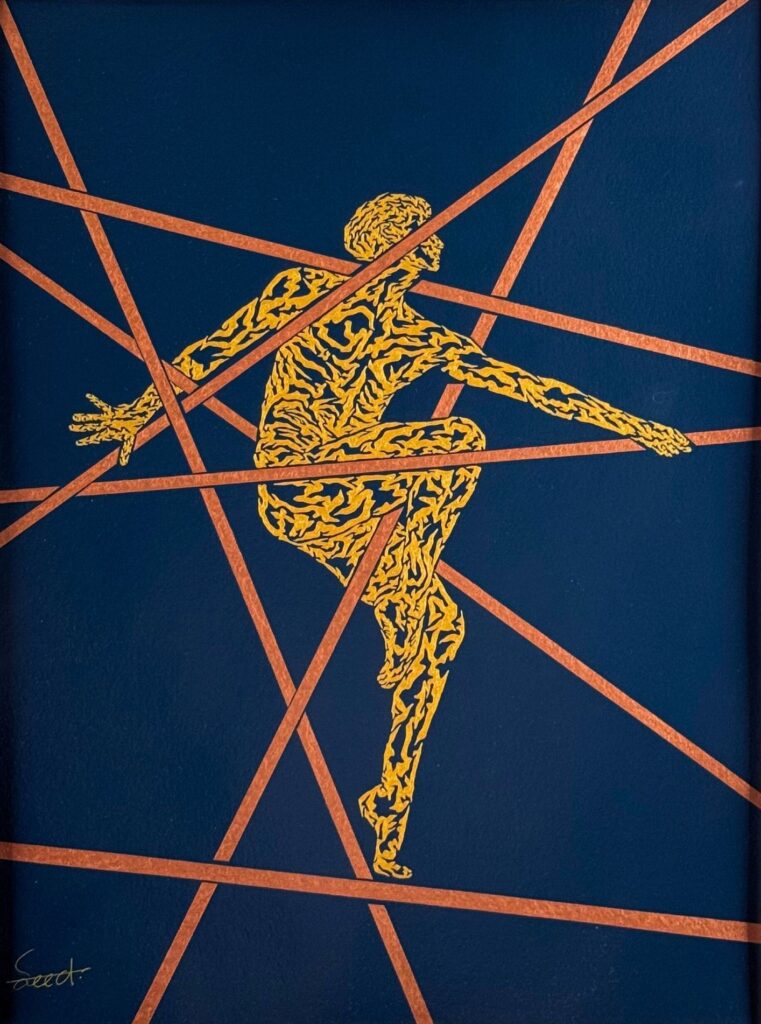
There are a number of works in which people are confined by thick lines, boundaries. “I showed them at my exhibition ‘Point of Stability’. People in power impose boundaries on other people. They treat those people like puppets. As ordinary people, we try to live with those boundaries. There is a close-up painting where it looks as if there is no boundary, but next to it hangs the full work, and you see that this person, too, has to deal with boundaries.

In another work, we see a circle: the moon; it is in shadow light. The black is the shadow. Around it, we see two dancers, a man and a woman. “The woman is really important in life. In my culture, man controls everything. Here in the Netherlands, a different culture prevails: women do many things, you are a woman and you can do whatever you want.”
Everyone can fly
Humans have many possibilities, but are often kept small, he says as we look at a human with wings. “Because of bullying, we have no energy left, but people can ‘fly’, everyone can fly. We don’t even need to speak, we can do it with our body language.”
When he arrived in the Netherlands, he went into therapy. “A therapist can talk to you and indicate your solution. But ultimately, you have to do it yourself.”
He shows a poster from his exhibition on Arabic culture, with Arabic calligraphy next to the figures. He had that exhibition two and a half years ago in a gallery in the Jordaan. Next to one figure is the text ‘Salam’ (peace). Next to another figure is ‘Just give me peace for my body’.

The Dream Project
He has had three exhibitions in the Netherlands; before that, two in Syria. In Lebanon, he made short films, and in Hungary, he studied English language and literature.
He has a dream that he has given shape to in The Dream Project. In a glass house, he is going to paint on glass. “It is about peace. I am going to depict various people on glass; these could be refugees, workers coming from abroad. I made a 3D max photo.” He shows the photo. It does indeed look like a glass house, the Glass House of Serious Request. “I want to give the viewer a certain feeling with this. There will come a moment when this project will be realized. I am also convinced that a museum will exhibit this glass house.”

Finally, what is his artistic philosophy?
“It’s about the human. Art is not necessarily something sweet, something that fits well on the living room wall. Art is feeling. I paint no persons, but feelings. And people can let that sink in.”

Images: 1) Be Free, 2) Blind, 3) Infinity, 4) Certainty 5) Controlled, 6) Destiny, 7) In the shadow of the moon, 8) Solemnity, 9) No matter how bitter, it will pass, 10) portrait photo Saeed Zamzam
https://www.instagram.com/saeedzamzam/
https://www.facebook.com/saeed993/?locale=nl_NL
https://4everjang.com/art/index.php
https://inzaken.eu/index.php/2026/04/26/saeed-zamzam-schildert-geen-mensen-maar-gevoelens/


Leave a Reply