
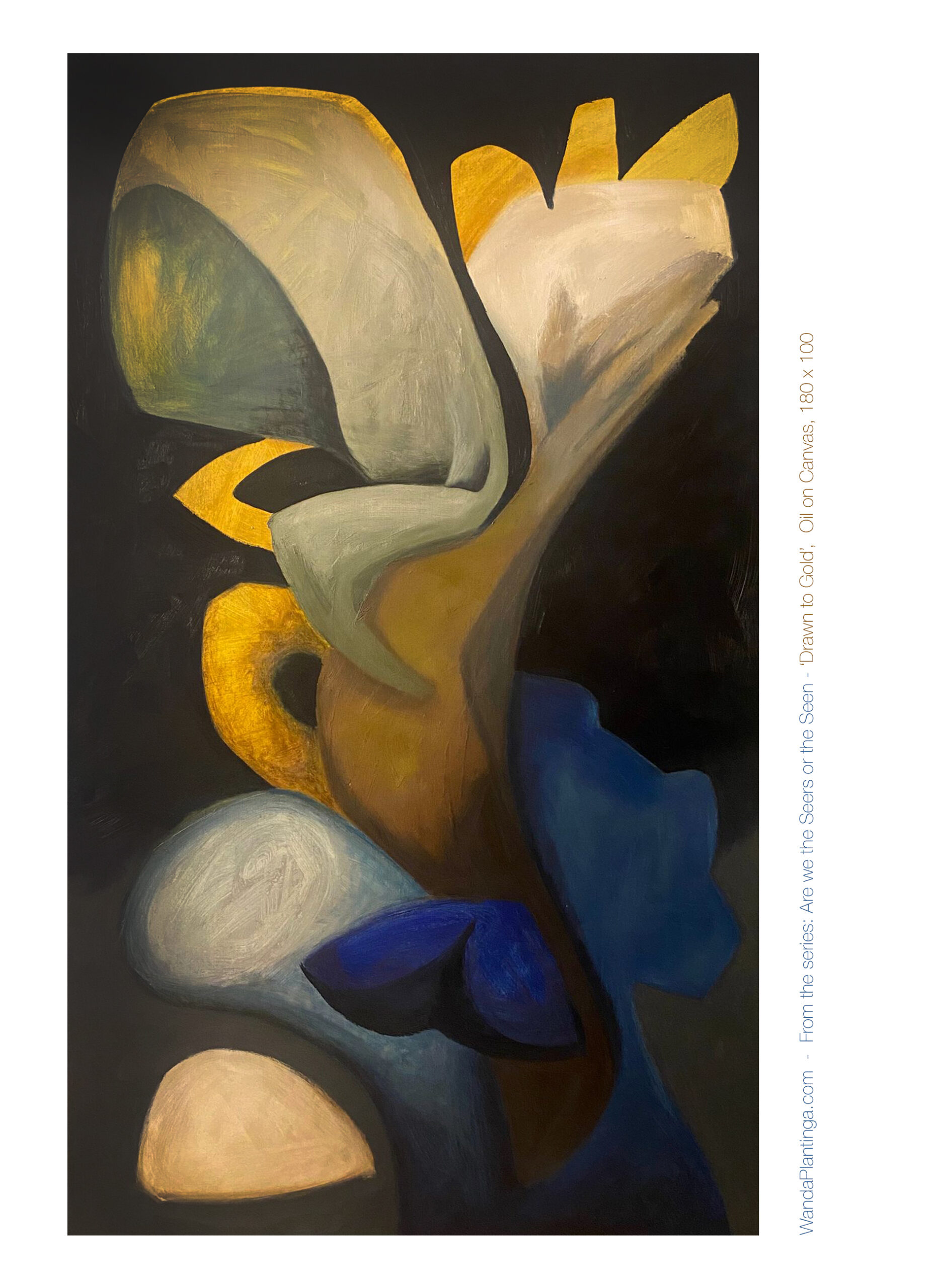
In the Mesdag Room at Pulchri, I saw a series of large-format works by Wanda Plantinga. It was part of a joint exhibition featuring her work alongside that of Mansour Bakhtiar—though he contributed only a single piece, while all the other works were by Wanda. I had interviewed Wanda previously, in 2017 (see elsewhere on this site), but this work was entirely new in terms of materials, content, and form.
I am speaking with Wanda about this series in the café of the Stedelijk Museum in Amsterdam. It began in Nice in 2022, she says. She has a holiday home there with a studio, and that year she created a series of masks. Take a look at the painting with the green face (Image 8).
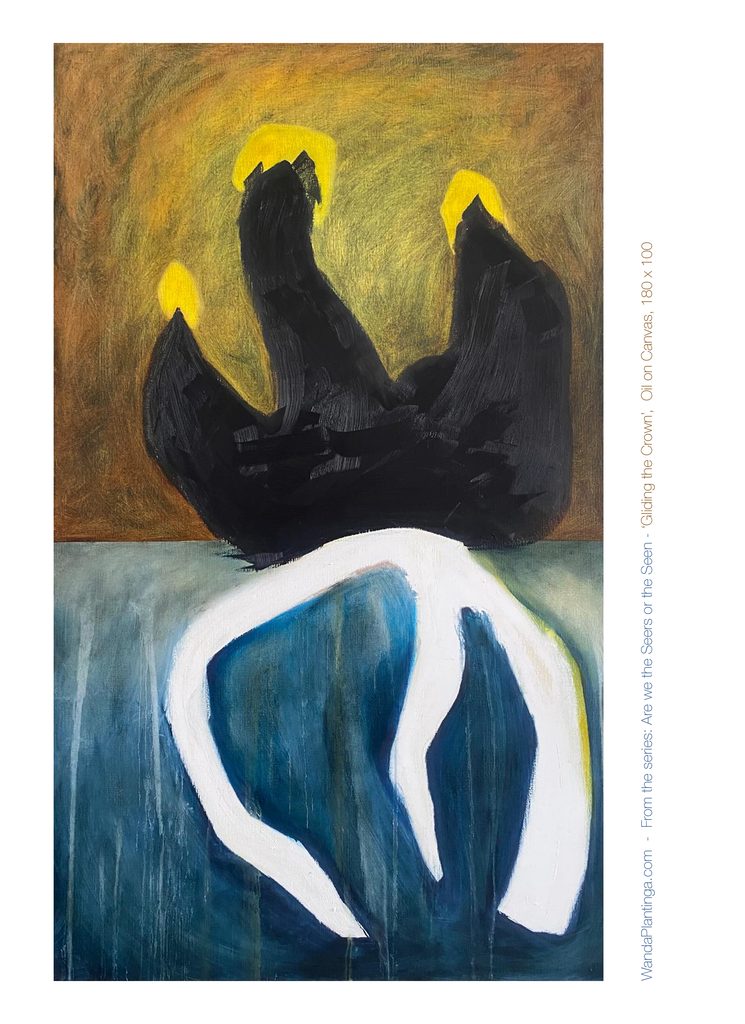
“That’s where it started. It begins with the question of where things went wrong for us humans—always in conflict.” That is why she returned to life before the imposition of meaning, to a time when everything was peaceful and serene. “I played with form; shapes broke free and began to float. This resulted in the series of twenty canvases which is shown at Pulchri till June 7th. That is only half the story. There are many more to come. Then it will form a complete whole.”
Are We the Seers or the Seen?
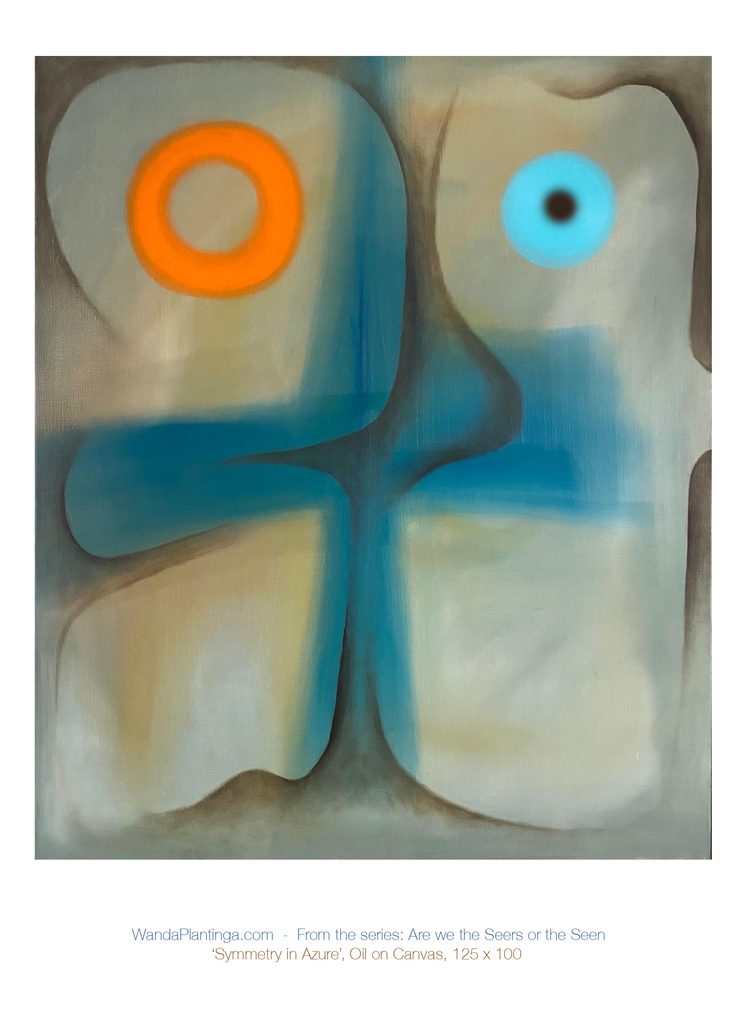
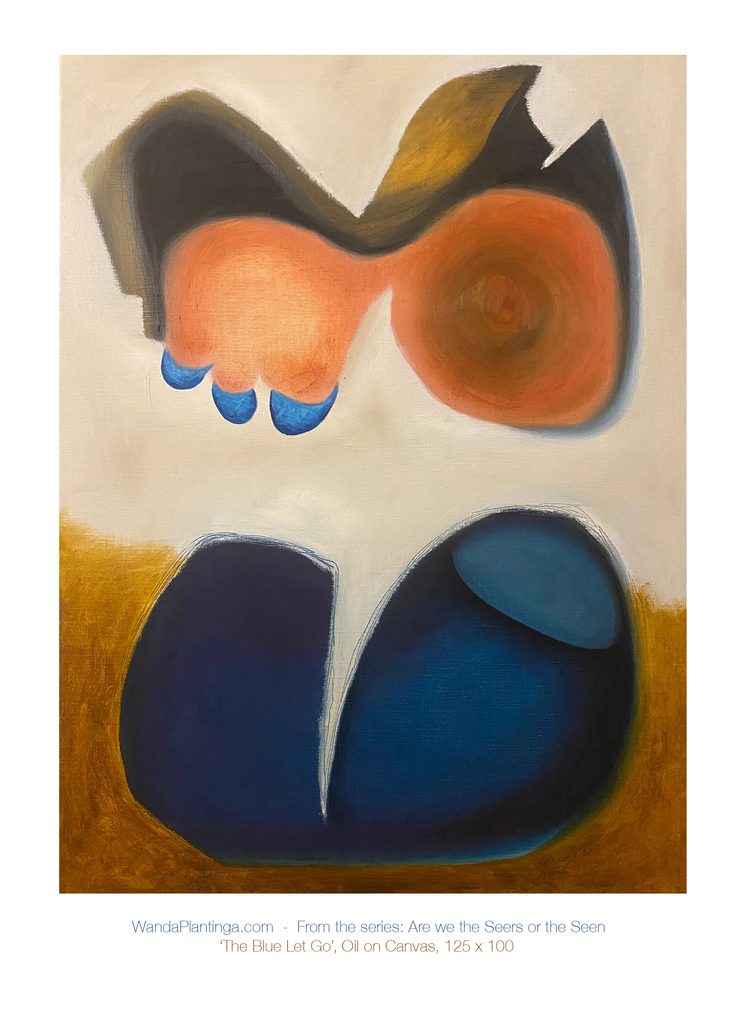
The title of the series is Are We the Seers or the Seen? When you look at the world today, you see a great deal of war and misery. Was there ever a moment free of conflict, Wanda wondered, and could she paint that? That train of thought led her to the origins of life—to the very first cells. The work seeks a moment of pure stillness. “I started with nothing; then a cell appeared, surrounded by silence. Things move quite quickly after that: two cells emerge.”

The forms began to float: moving upwards and downwards. The first fine hairlines appeared—lines that would later become significant. She had jotted down the stages on paper: from cells to vegetation, insects, animals, and finally, humans. “As soon as humans appear, things get difficult and grimmer. Humans are complex.” It ends with the humanoids—human-like beings. “They are completely locked within themselves, having no contact with others. That mirrors the initial state. We, as humans, need to move towards one another again, to reconnect.”
Broad painting movements
Wanda had discovered the pleasure of applying paint to canvases measuring 1.80 by 1 meter using broad movements originating from her shoulder.
We see multiple elements in the space.
I love taking on the challenge. These are unfamiliar forms, yet they belong to my visual language. I want to move forward—not to paint familiar shapes, but to create a form that has never been seen before. To paint what has not yet been seen, so that what is not there becomes visible.”
Why is this theme important to her?
It is important for her to remain true to the values that define her artistry, she says. “That means continuing to seek my own signature style without losing sight of tradition. I carry the great masters with me, as it were; they form an internal frame of reference rather than serving as models to be imitated. My ambition is to further deepen and expand the visual language I have developed over the past few years, so that it acquires meaning within the times we live in. That is important. Not by following trends, but by visualizing contemporary reality through a unique, authentic visual language.”
Does Wanda have a keywork?
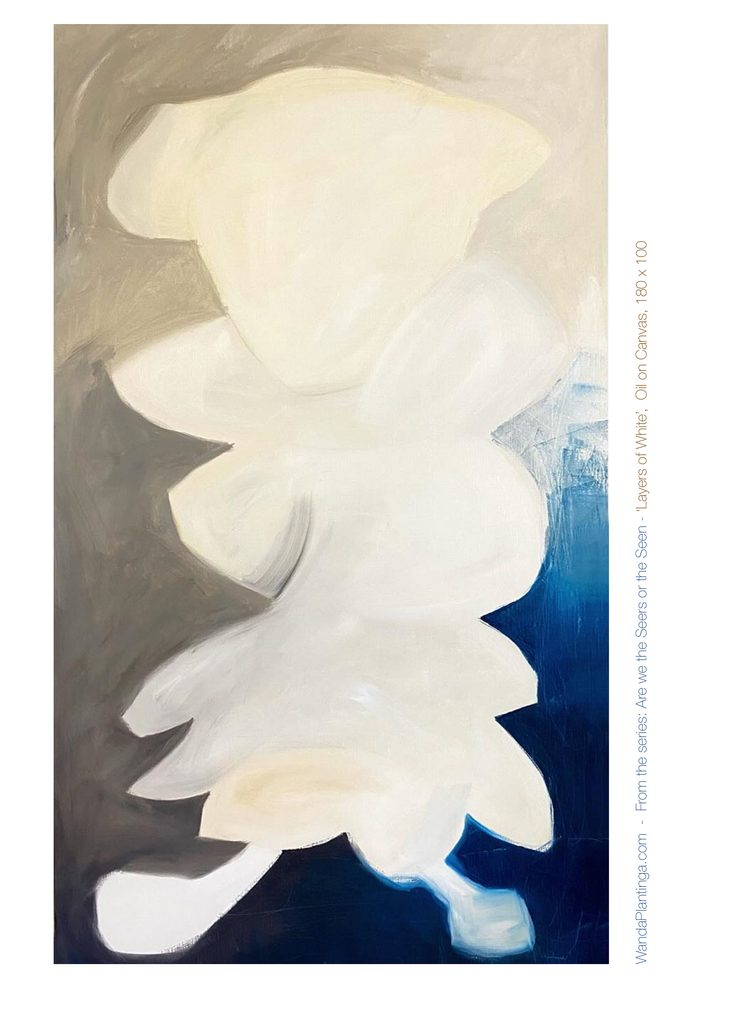
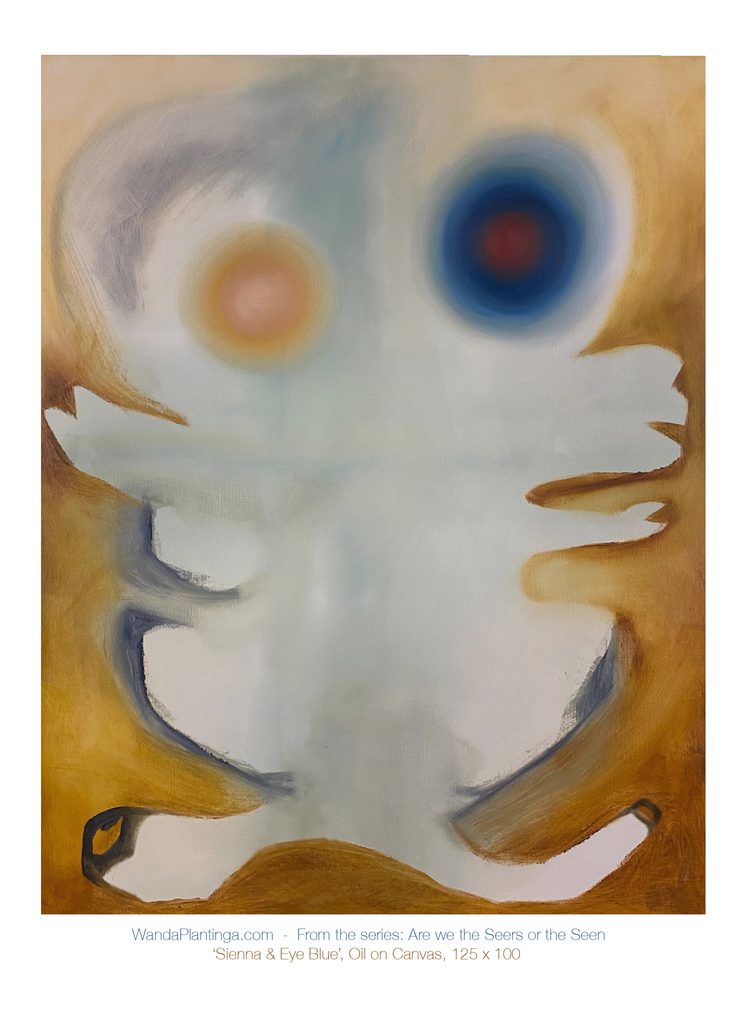
She does. It is the masks—starting with the green face, followed by her discovery of space and forms within the face (see images 8 and 9). Additionally, the start of the new series—featuring ‘Layers of White’ and the first works involving cell formation—also constitutes a keywork (see images 3–5).


Layered Cultural Heritage
Wanda Plantinga was born in the Netherlands and began her artistic training at ArtEZ, the Academy of Visual Arts in Kampen. “My artistic practice took shape across several continents. I worked in the world of design and advertising in Jakarta, after which I continued my studies at the Heatherley School of Fine Art in London. It was there that graphic art became central to my work. It marked a turning point: shifting from realizing the visions of others to developing my own distinctive visual language.”
Her work is inhabited by creatures that are at once monstrous and tender—dreamlike forms in which a layered cultural heritage from Indonesia, Switzerland, and the Netherlands converges. “Nature, a constant presence in my life, resonates in my work through understated yet powerful colors, ritual gestures, and monumental forms. Since moving to Nice, France, in 2022, my work has evolved towards greater simplicity, while I consciously draw upon my Asian heritage.”

She is currently in Amsterdam for a while, working in a studio near the Concertgebouw, but will eventually return to France—partly to finish a series of large canvases measuring 3 by 1 meters, which are also part of ‘Are we the Seers or the Seen’. “I feel an increasing need to paint. I want to work on a large scale, monumentally. I love color, and I understand color. To me, they are French and Italian colors: emotional, warm, and dramatic.”
“But as you know, I have done a lot of etching. Perhaps in the future, the delicate will merge with the monumental. That strikes me as a wonderful direction: monumental paintings with the precision and attention to detail of an etcher.”

Finally, what is her philosophy?
“I am convinced that when you create honest and original work, it always finds its audience. Making art is hard work; staying honest is perhaps even harder. That is why I try not to create beautiful images, but images that reveal something.”
Images: 1) Drawn to Gold, 2) Gliding the Crown, 3) Layers of White, 4) Ocean &Yellow, 5) Sienna & Eye Blue, 6) Symmetry in Azure, 7) The Blue Let Go, 8) Who, 9) Mask Red Crown, 10) Transparent with Yellow, 11) Wanda Plantinga in action
https://wandaplantinga.com/
https://www.pulchri.nl/nl/tentoonstellingen/wanda-plantinga-mansour-bakhtiar-stilte-naar-strijd/
https://www.instagram.com/wjjplantinga/
https://inzaken.eu/index.php/2026/08/04/wanda-plantinga-schildert-wezens-die-monsterlijk-en-teder-tegelijk-zijn/